
Visual art reviews: Debjani Banerjee | Katie Downie | Duggie Fields | Jeremy Deller


Debjani Banerjee brings gorgeous images to CCA, while Katie Downie captures the spirit of Joan Eardley
Katie Downie: Conversations with Joan Glasgow Women’s Library ★★★★☆
Duggie Fields: Less is less, more or less (From the Archives) Modern Institute, Glasgow ★★★★☆
Jeremy Deller Modern Institute, Glasgow ★★★☆☆
News that two of Scotland’s leading contemporary art spaces face an uncertain future is grave tidings indeed. CCA in Glasgow is to close temporarily in December to “concentrate on restructuring”. And, following Creative Scotland’s announcement of a three-month delay to its decisions on multi-year funding, Dundee Contemporary Arts issued a statement saying they are “running out of ways to maintain our activity at its current level”. After years of barely keeping its head above water, Scotland’s arts sector is badly in need of some investment and some stability.
Meanwhile, artists keep doing what they do, and CCA is showing work by Edinburgh-based Debjani Banerjee. Recently, the gallery has hosted a range of artists from diverse cultural backgrounds who have drawn on their own traditions to create contemporary art which has a distinctive flavour. Banerjee invites us into a world of South Asian stories, beliefs, decoration and music.
Jalsaghar is Bengali for Music Room (and also the name of a Satyajit Ray film from 1958), and the first of the two galleries is transformed into a space for listening, relaxing, contemplating. Visitors are invited to take their shoes off, walk on the mirrored floor, sit on the cushions or decorated benches and listen to traditional Indian songs mixed with softly throbbing electronic beats by Banerjee’s sister Mita Pujara and her partner Kavi Pujara.
The works in the larger gallery, hand-stitched banners and ceramic sculptures, draw on The Mahabharata, Hindu deities and Banerjee’s own family history, particularly emphasising the female perspective. One quilt, ‘That floats on high o’er vales and hills’ (a quote from Wordworth’s Daffodils poem), shows a woman in Indian dress, likely Banerjee’s mother, in the Welsh landscape to which she arrived from India in the 1960s. There are intriquing juxtapositions of Britain and India, exotic and mundane: snakes emerge from Henry the hoover, an Edinburgh Leisure wristband features on a ‘Kali Apron’.
Nat Raha’s helpful essay is essential for those of us who lack the specific Indian/Bengali cultural reference points and stories. We need Raha to tell us Banerjee is also concerned not only with history and migrant stories but with violence against women in India today. Left to itself, the show is an assortment of works which don’t quite hang together, at least to Western eyes, a mix of gorgeous decoration, humour and quirkyness which is also aiming at something more hard-hitting. While there’s plenty of ambition here, the artist doesn’t do quite enough to pull the audience along with her.
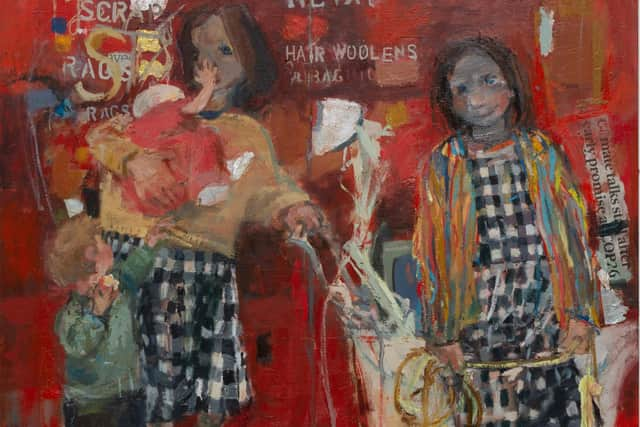
In 2021, Kate Downie was invited to “finish” ‘Two Children’, the painting left on the easel of Joan Eardley’s Townhead studio when she died in 1963. Applying her trademark energy to the project, Downie developed not only a dialogue with Eardley - she calls it “art history from the inside” - but a wider conversation with a group of children and their families local to her Fife studio whom she drew, observed and painted.
From this has emerged a body of work now on show at Glasgow Women’s Library, including the “finished” Eardley (Downie repainted it from scratch working from a print-on-canvas copy - the original is in the Glasgow Museums collection and, sadly, isn’t part of the show). Studying Eardley’s work, as well as the interactions of her young models, she intuited that the two children in the picture - Pat and Ann Samson - were holding two younger siblings, a toddler and a babe in arms, whom Eardley had not yet added. ‘Four Children’ is a vibrant picture which mingles now and then, Downie and Eardley, two women artists conversing through time.
But it doesn’t stop there. As well as including her drawings and oil sketches of the children – which are superb and sometimes very Eardley-esque – and a superb drawing of Ann Samson as an adult, there is a much larger banner-style painting, ‘Dead or Alive’, in which the children made their own marks. Letting them draw while she painted (as Eardley did), she then worked over their sharks, dinosaurs and scribbles, before adding figures of her own against a rich red background similar to the one Eardley used.
It gives the project a much more contemporary flavour. If ‘Four Children’ has Downie moving into Eardley’s world, ‘Dead or Alive’ brings an Eardley sensibility into the 21st century.
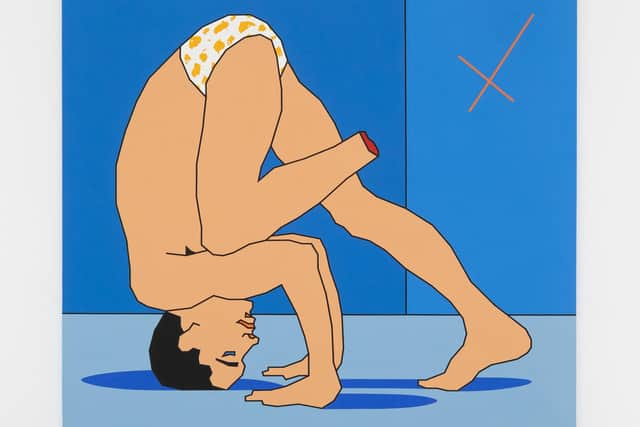
The spirit of an artist who has died is also present in ‘Less is less, more or less’, the show created at Modern Institute from the archives of Duggie Fields. The gallery made a glorious show recreating parts of Fields’ Earls Court flat for Glasgow International in 2018. Fields died in 2021, and this show is quieter, a loosely chronological walk through the artist’s closely interwoven work and life.
Selected archival material helps explain his journey towards his signature painting style: a kind of melding of pop art, figurative painting and hard-edge abstraction. In addition to paintings, there are drawings, postcards, photographs, objects from his flat, comic books and furniture as well as fashion, advertising and pop cultural reference points on a spectrum from Disney to Kraftwerk. It’s particularly interesting to see the laborious way he created his paintings (at least those made before the digital era), using grids and graph paper to enlarge his drawings.
Fields worked across painting, fashion and design, as well as music and performance (not featured here). A style icon in himself – featured Commes des Garcons on the catwalk in 2007 – he had was doing postmodernism well ahead of the curve. There is surely plenty left to say, but this show is a fascinating guide to what formed him, a man who carved out his own path and then walked it, gloriously and irreverently and remains never less than interesting company.
As does Jeremy Deller, whose arrival at Modern Institute is always a cause for celebration. This show is dominated by banners made by his regular collaborator Ed Hall, many of which were used in Procession, the work he created for Manchester Festival in 2009, along with a small group of works from his show for the 2013 Venice Biennale. In the centre of the main space at Aird’s Lane is a meticulous reconstruction of Valerie’s Snack Bar, from Bury Market, Manchester, which was also part of Procession, where you can sit in an orange bucket seat and enjoy a free tea and coffee.
Deller’s interest in what makes up grassroots British culture is surely never more prescient: that mix of history, politics, humour, odd traditions and backyard enthusiasts. It’s particularly good to see again the film, English Magic, made for Venice, which goes on a journey referencing from Abbey Road Studios and a car-crushing machine in a scrap yard to the odd pageantry of the Lord Mayor’s Show and Deller’s own Stone Henge bouncy castle, all while the Melodians Steel Orchestra plays arrangements of Vaughan Williams and David Bowie.
A work like Procession, however, lives in its moment, with many of its references specific to its time and place. It dominates the show perhaps a bit too much, feeling, already, like a piece of history, or the rumour of an excellent party to which one wasn’t invited.
Debjani Banerjee: Jalsaghar until 30 November; Kate Downie: Conversations with Joan until 25 January; Duggie Fields: Less is less, more or less (From the Archives) until 6 November; Jeremy Deller until 21 December
Comments
Want to join the conversation? Please or to comment on this article.