
‘To understand Peter Howson’s paintings, you must first understand his faith’
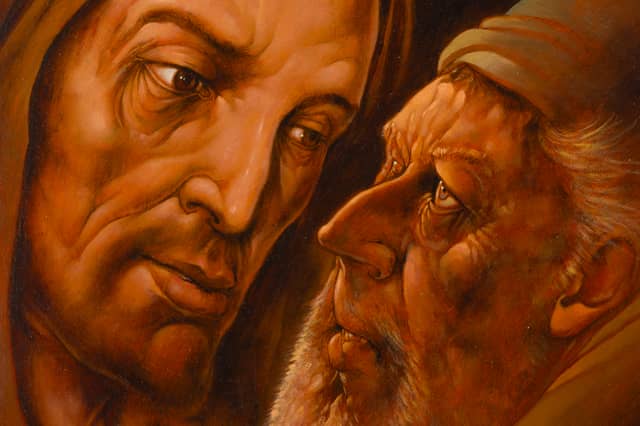

As he publishes a new book about Peter Howson, John Miller argues that a significant aspect of the artist’s work has been overlooked
Peter Howson has long been recognised as one of Scotland’s foremost figurative painters. This has been affirmed by the major retrospective exhibition held in Edinburgh's City Art Centre in 2023. Yet I consider that few of his admirers, few even of those who collect his work, have understood the basic perspective from which he paints. For his outlook is that of a Christian believer. Howson is a Christian mystic.
Since his work first came to public attention, there has been a regular flow of views about his style, his imagination, his choice of subject. The catalogues for his many solo exhibitions contain the considered opinions of a wide range of art critics and art historians. Three major reviews of his life and work have been published, two written by Robert Heller, the journalist and management specialist, the third by the journalist Alan Jackson. In addition, Howson’s life and work have been the focus of a number of television documentaries.
So why did I decide to write a new book about him? I am not an art historian, nor am I an art critic. In those respects I can add nothing to what has already been written. On the other hand I spent my working life as a Church of Scotland minister in an urban parish. As a consequence, I was consistently involved in discussing with people their experience of life and suffering, grief and tragedy, violence and murder, the effects of poverty, illness and disability, the presence of death. I am familiar, therefore, with the territory in which Howson has located much of his work. At the same time my working life asked me to respond to these challenges in the light of a Christian faith.
A young couple who had suffered a tragedy of their own once gave me a book about William Blake. Their kindness introduced me to an artist of whom I knew little. I warmed to Blake’s presentation of darkness surrounded by light, and his understanding of the interweaving of good and evil.
When I first encountered Howson’s work I was at once reminded of Blake. When I saw the hunched shoulders of the man taking The First Step, I sensed the suppressed power which he was holding in restraint.
My mind at once turned to Blake’s The Ghost of a Flea. In explanation of this painting Blake told his close friend John Varley that he had been visited by the spirit of the Flea, and "while drawing the spirit, it told the artist that all fleas were inhabited by the souls of men who were by nature bloodthirsty to excess." In the painting, The Flea holds a cup for blood-drinking and stares eagerly towards it.
Features of Blake’s Flea are reflected in many of Howson's paintings. In, for example Mr Great Heart, you can see the aggressive movement from right to left; the hunched shoulders; the bloodthirsty attitude; the prominent bones of the spine.
Howson affirmed the connection. He still remembers visiting the Tate Gallery at the age of 12, and the impact that The Flea made on him: "I saw it in this dark room," he said, "in its soft light, this tiny tempera. It has inspired me."
Howson is enthralled by Blake’s mystical emphasis, his capacity to live in a state of spiritual awareness. "I love to hear of how his friends would come to the door," says Howson. "They would ask Mrs Blake if they could see William. 'Well,' she would reply, ‘he’s upstairs, in heaven.’ Howson is very much at home with Blake’s readiness to see the limitless presence of God dwelling within the confines of the natural world.
On the other hand, Howson also gained experience and understanding of a darker side of human life. In response to school-day bullying Howson learned how to become fit and strong, and he enjoyed using physical force. Drawings from his Army days present the appeal and the menace of masculine strength. After leaving the Army Howson took part-time employment as a bouncer in an Ayr dance hall. He enjoyed the fighting which was a regular part of a bouncer’s job.
Howson began to paint the hard, physical life of many working class men. Collectors recognised the reality which he depicted. Cultured middle class professionals wanted to put Howson’s tough working men on their walls.
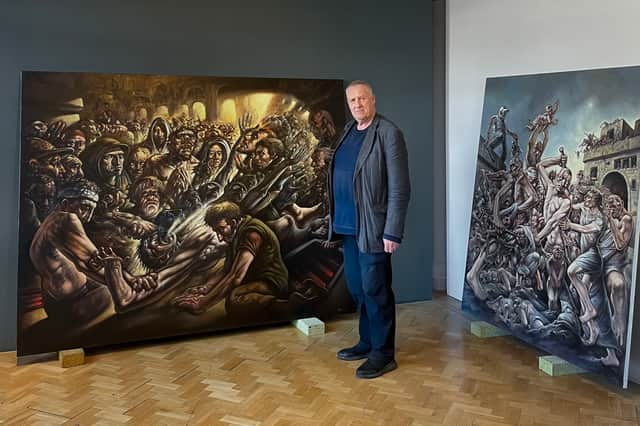
A perspective of compassion accompanied Howson when he was an official war artist during the war in Bosnia. Women whose bodies had been impaled on the sharpened trunks of small roadside trees awakened in Howson his awareness of the sufferings of the innocent. In many pictures, from this and later times, a victim suffers. Man or woman, the target is attached to a cross-like pole. Crowds of hostile characters shout and throw missiles at the cross’s defenceless occupant.
However, the ferocity of Howson’s images, the darkness of his perspective, has effectively obscured the underlying Christian message of his work. The BBC TV documentary titled Prophecy traces in detail the process by which Howson produced the brutal painting of the same name. The picture, with its title, provides the key to understanding the relationship between Howson, the subject matter of so many of his non-religious paintings, and his Christian faith. In much of his work Howson depicts the dark destructive side of human activity. It is as if he is obsessively focused on the human capacity for terror, menace and destruction.
But the title of this particular painting, together with Howson’s own spoken reflection on it, indicates that in these frightening images Howson is issuing a warning. In the painting he is displaying the annihilating effect of unbridled human impulses. But rather than being indifferent to the cruelties he depicts, and far from promoting such a view of humanity, he is presenting the subject as a warning. In his own words: "This is what lies within us all. All of us are capable of activity like this."
By contrast Howson asserts that the only corrective, the only antidote, the only atonement for such remorseless destruction, is love. As demonstrated in his Fourteen Stations of the Cross, for Howson that love is embodied in the sufferings of the innocent, in the crucifixion of Jesus Christ. That is the only answer. This is the painter’s prophecy.
John Miller is a retired Church of Scotland minister and former Moderator of the General Assembly. His book Steps: The Spiritual Journey of Peter Howson is published by Handsel Press, price £25
The Scotsman’s arts newsletter is now sent twice a week - subscribe today
Enjoying the Arts & Culture journalism on scotsman.com? Make it easier to find by selecting us as a preferred Google source
Want the latest Scottish headlines sent directly to your phone? Sign up to our new WhatsApp channel here
Comments
Want to join the conversation? Please or to comment on this article.