
Royal Scottish Academy 200th Annual Exhibition, Edinburgh review: 'a wonderful miscellany'
This year’s theme may be time and its passing, but as always the RSA’s Annual Exhibition embraces a hugely diverse range of subjects and styles, writes Duncan Macmillan


The 200th Annual Exhibition, Royal Scottish Academy, Edinburgh ★★★★★
This is the bicentenary of the Royal Scottish Academy. In 1826 a small group of artists broke away from the Institution for the Promotion of the Fine Arts in Scotland to found the Scottish Academy. The Institution was run by establishment figures who felt they needed no input from the artists whose work they exploited profitably. The proposed Academy was a secession, indeed a rebellion. Consequently quite a number of the artists got cold feet and backed off. Nevertheless, on 27 May 1826 the 13 remaining brave seceders held their ground and declared themselves the Scottish Academy.
Holding their first exhibition in February 1827, defiantly opening on the same day as the Institution’s show, their takings were considerably better. The Institution did not give up however. Installed in the new, purpose-built building that we now call the RSA, they managed to block the Academy’s application for a Royal charter while securing one for themselves. The Academy became the Royal Scottish Academy only in 1838. Meanwhile the artists who had chickened out changed their minds. After some ticklish negotiation they joined the new Academy. In consequence, the Royal Institution which had undervalued the artists now found it could not do without them. Very soon the Academy’s annual exhibitions had replaced the Institution’s in the building which continued to be known as the Royal Institution until in 1911, given to the Academy, it became the RSA.
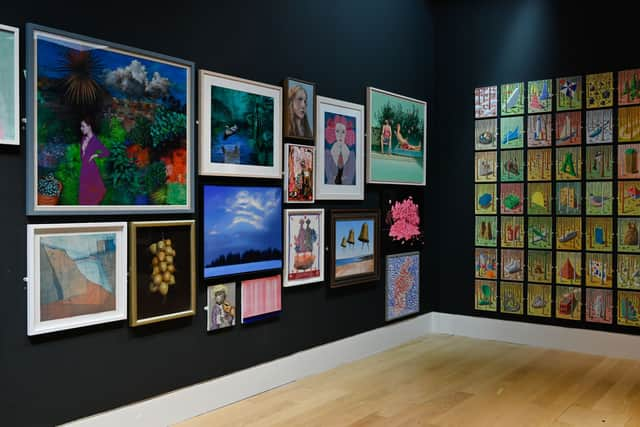
With nearly 600 works, not counting architecture, and some of them pretty big both in scale and ambition, this year’s Annual Exhibition is well fitted to mark the bicentenary. Academicians are entitled to send in their work sight-unseen so long as it within the set parameters. Everybody else submits work online and “in” or “out” is decided by vote in the hanging committee. Somehow the very diverse result has then to be hung in a way that looks coherent. This year it works very well, but there is also work by nearly a hundred more exhibitors online.
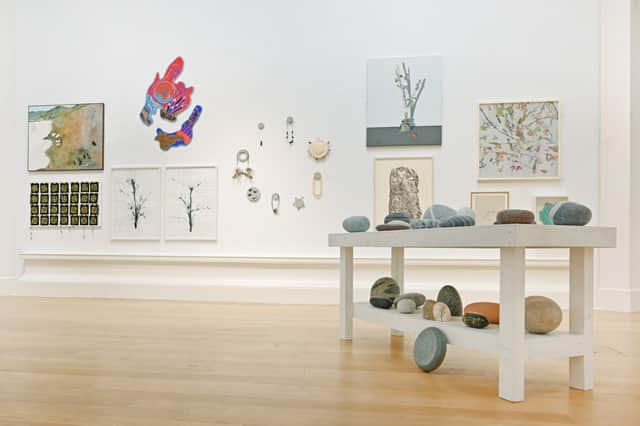
If the RSA’s bicentenary is on 27 May, the tercentenary of James Hutton is just one week later, on 3 June. Hutton’s insight into the true age of the earth, and how its geology is not fixed but constantly changing, has shaped our entire understanding of the world and our place in it. So Annie Cattrell, the exhibition convenor, has taken Hutton and time as a theme for the show. Kate Whiteford has met this directly in a wall-sized piece which combines photographs of the site on Arran where the overlapping layers of rock gave Hutton a critical breakthrough, with graphic renderings of recordings of the underground soundscape - echoes of the earth’s restlessness. She sets this in context by revisiting her brilliant 1984 installation on Calton Hill. Jake Harvey goes straight to geology with a display of beautifully polished stones, specimens perhaps of different geological ages. Landscape Portrait (North East) by Mary Bourne does something a little similar with four mountain forms in four different Scottish granites.
Glen Onwin’s seven large and varied glass disks suggest we reflect on the very different theory of the earth proposed by Thomas Burnet in his Telluris Theoria Sacra or Sacred Theory of the Earth, published in 1681, which Onwin has taken for his title. The seven disks might be stages in the earth’s evolution or stages in our understanding of it. The dawn of time itself seems to be captured in Thomas Joshua Cooper’s large photograph, a pitch black long-exposure of the sky with a single streak of light from the rising crescent moon. Stephen Skrynka gives us Deep Time with infinitely slow-moving but nevertheless viscous tar in an hour glass. Invited artist Cathie Pilkington seems to take us back to ancient Greece with an assembly that looks like a snapshot of Phidias’s worship as he worked on the Parthenon frieze.
Calum Colvin also reflects on what we make of our cultural past with his big, two part Mask of Keats. The poet’s outsize death mask, rendered not in plaster, but in some gauzy substance, fills a library. In the first image, like Miss Havisham’s house, time has clearly passed, indeed standing stones have broken through the floor, but really it has all just got a bit jumbled. Then in the second image the mask is caught in a net, the poet’s reputation trapped like a butterfly. Two Arctic landscapes by Barbara Rae seem like pictures of a landscape literally frozen in time. Nearby Matt Draper conforms to the time theme to the extent that he gives the precise time and date for his magnificent pastel of sea, clouds and sky.
Over the Far Horizon by Kenny Hunter is a beautiful sculpture of a little boy launching a toy boat, symbol of his setting out on the journey of life. Next to it is one of the most exquisite images here. By Alison Watt and called Vanitas, it is a picture of life’s other end, a beautifully painted single skull. These reflective pieces are joined in their theme by another of the truly standout works here, Ken Currie’s masterly Ferryman. It is a full-length of a figure standing in a boat, almost overwhelmed by darkness. He is surely Charon ferrying departed souls across the river Styx into the underworld.
Of course not all here is so deep and dark, nor even reflective of time and its passing. Indeed, the show as ever is a wonderful miscellany. Joyce Cairns has painted a charming portrait of past-president Arthur Watson surrounded by members of the Academy’s standing committee, including herself, his successor as president. Nearby Barry McGlashan’s At Midnight is a big and wonderfully dreamy blue picture of the moon over water. Francis Convery’s Cycle Path is just a lovely piece of painting. So too is Zuzanna Salamon’s I hope you will stay, in which a girl seen from behind, like Eve, is holding an apple. In Victoria Crowe’s Holding Winter Fire, scarlet dogwood holds its own against the red of an evening sky, while Callum Innes’s big abstract CI C 53 superbly commands a whole wall.
If the upper galleries are dominated by large works, downstairs they are mostly smaller, they are hung closer and the mood is different. Indeed, works here like Helen Flockhart’s Fruiting Body, a scene in a mysterious bedroom, or Ian Westacott’s marvellous etchings of ancient trees, benefit from close viewing. So too does Deirdre Nicholl’s little blue and white Beltie, one of a series of sculptures she is doing of rare breeds. Toby Paterson, usually an artist of would-be utopian cityscapes, catches brilliantly a quite different mood in F35’s over Sandaig. Ian Ritchie’s abstract woodcut, Study in Light 2, is simply beautiful. So too are Gordon Mitchell’s Baywatch, two boats drawn up in a sandy bay, and James Fairgrieve’s Onions. Equally exquisite is Susie Leiper’s wonderful illuminated manuscript of Nan Shepherd’s The Living Mountain. The long-ago monks in their scriptoria would have been proud of it.
Like Salvador Dalí’s melting cups and saucers, Livia Marin’s Broken Things is a ceramic teapot that seems to have melted and flowed out across the plinth. Samuel Beckett loved cats and so James Castle has made one in his honour but with a very long tail, and Magid Magid’s Pink Wedge is just that, a very big pink wedge. There is indeed much here to see and to enjoy, even outside the building where Sam Ainslie’s banners bring brilliance to Prince’ Street.
Until 14 June
The Scotsman’s arts newsletter is now sent twice a week - subscribe today
Want the latest Scottish headlines sent directly to your phone? Sign up to our new WhatsApp channel here
Comments
Want to join the conversation? Please or to comment on this article.