
Resistance, Edinburgh review: 'a century of activism in photographs'
Charting the history of protest in the UK from 1903 to 2003, Resistance is an important and interesting show, but it would feel more alive if it was better connected to the protests of recent times, writes Susan Mansfield
Resistance: How Protest Shaped Britain and Photography Shaped Protest, National Galleries of Scotland: Modern Two, Edinburgh ★★★★
The history of protest seems to be having a moment. Women in Revolt at Tate Britain last year, which travelled on to Modern Two in Edinburgh, broke new ground as a major survey of women’s activism, while Outside the Circle at Dundee’s Cooper Gallery, which ran from last autumn until February, brought together art, archives and ephemera from a wide range of movements on a smaller scale but with scarcely less ambition.
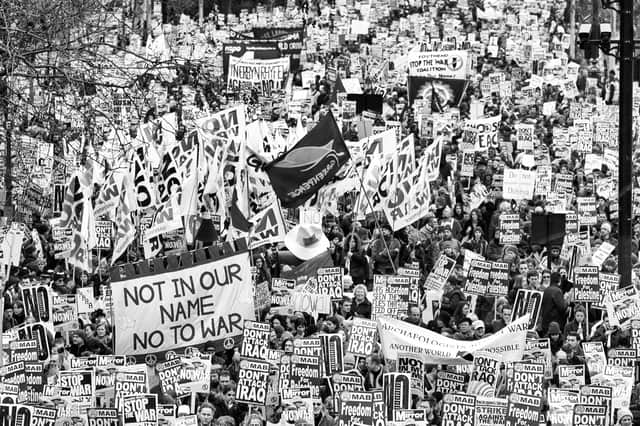

Now, Resistance, conceived by the artist and filmmaker Steve McQueen and curated by Clarrie Wallis, arrives at Modern Two from Turner Contemporary in Margate. Years in the making, it’s a century of activism in photographs, a kind of history of Britain through the lens of protest. Beginning with the Suffragettes in 1903 and ending with the protests against the war in Iraq in 2003, it traces a line through hunger marches, civil rights, gay rights, environmental activism and much more. Some of the movements depicted here are barely recalled today, others are etched on the memory; some led directly to change, others were apparently fruitless, though they have an important legacy.
The Suffragettes prove a useful place to begin as they were conscious, in quite a modern way, of the power of the photographic image. Oldham cotton mill worker Annie Kenney, eyeballing the camera and smiling as she was arrested, knew that a good photograph is worth a thousand words.
Even as the WSPU were tipping off press photographers about their planned actions, police were developing an early version of the telephoto lens to observe their meetings during daily exercise in Holloway Prison. The camera is rarely a neutral observer, and as activists learned to make it work for them, so did their opponents. In time, it would come to shape how both sides behaved.
Anti-fascist organisations also weaponised the camera. Even as a goose-stepping Oswald Mosley exchanged the Nazi salute with his Blackshirts in 1936, the 43 Group, led mainly by Jewish ex-servicemen, were taking covert pictures of the movement’s leadership and of people queuing up to join.
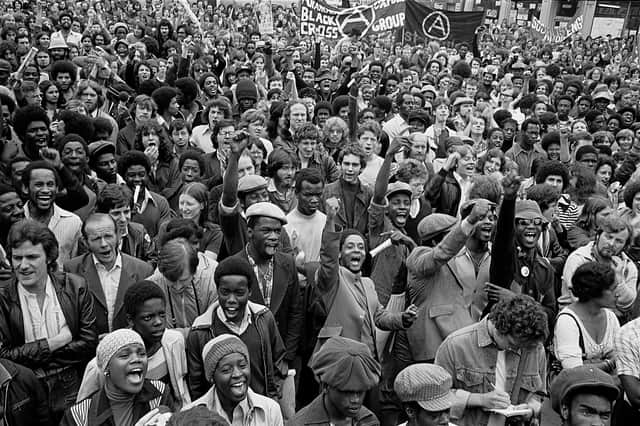
One of the most interesting things about the show, in a hang which is part chronological, part thematic, is the way themes recur across decades. A mass protest gathered to block a pro-fascist march through London’s East End in 1936, and again in Lewisham in 1977. A photographer captured the “Jarrow Crusade” of 1936 passing through the village of Lavendon in Buckinghamshire, at the exact same spot where another photographer snapped the People’s March for Jobs in 1981: the main difference in the later picture is the absence of flat caps.
Race activism is traced is some detail, and with nuance, from the founding of the Notting Hill Carnival in 1959, a defiant act of celebration after the racially motivated murder of a young black man, to the Black People’s Day of Action in 1981 which followed the New Cross Fire in which 13 young people died. This is one of the few areas in which small-scale activism is documented, with a rare photograph of a Saturday School, launched around London by parents and teachers to help black children, one of which McQueen himself attended.
There’s a whistle-stop tour of gay rights activism, from a 1927 photograph of men arrested for “corrupting public morals”, to the “kiss-ins” of the 1970s and 1980s, section 28 protests and vigils for victims of Aids. A rare photograph of the Blind March in 1920, its banner “Justice not Charity”, chimes with the Stop Telethon campaigns in the 1990 and 1992 organised by people with disabilities around slogans like “Piss on Pity” and “Parity not Charity”.
Part of the work of this exhibition is to reclaim and interrogate this history, and it is accompanied by a weighty book of essays to this end. However, taken purely as images, these pictures also invite us to consider how a photograph tells a story.
While photographs of large-scale protest marches are important documents - and there are a lot of them here - after a while, they all start to look similar. The images which are most interesting are often those by photographers embedded in particular communities: Keith Pattison in Easington during the miners’ strike, Janine Wiedel at Greenham Common, French photographer Christine Spengler in Northern Ireland at the beginning of the Troubles, Paul Trevor in the Bengali communities of the East End.
And some documented their own communities: Edith Tudor-Hart, working as a GP in the Rhondda Valley in the 1930s; Tish Murtha photographing those around her, including her own family, in her power Youth Unemployment series in the early 1980s.
This show brings together the work of many photographers, some of them anonymous, some on assignment, some committed to the cause they portray. Some are well known: John Deakin photographing delegates at the Fifth Pan-African Congress in 1945, Fay Godwin on the Right to Roam, Syd Shelton on Rock Against Racism.
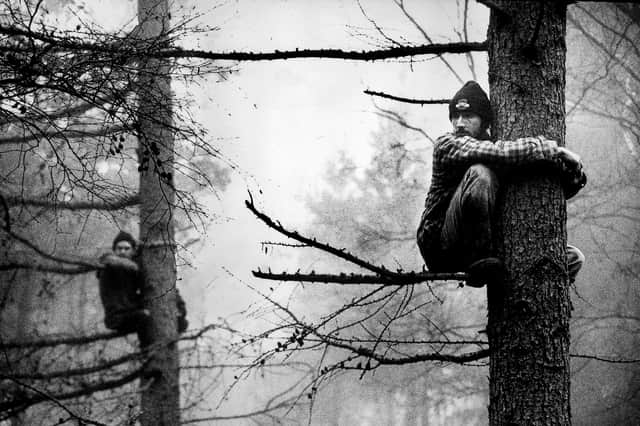
Andrew Testa’s pictures of tree-dwelling protesters at the Newbury Bypass are superb, helpfully augmented by Jeremy Sutton-Hibbert’s picture of the “car henge” at Glasgow’s M77 protest, one of a handful of Scottish images added in this iteration of the show. In general, the show does not stray too far from London, and causes without a London focus - the Belfast hunger strikes or Scottish independence movement, for example - are captured in the briefest of glances.
The images which stick in the mind are those which focus on small numbers of people: the family in Easington watching Arthur Scargill on the TV, the women of Greenham Common dancing on the roofs of silos, the image of Brian Haw, whose anti-war protest in Parliament Square lasted from 2003 until his death in 2011. The solitary figure, lying on his mattress, milk and Nescafe at his side, his face illuminated by his cigarette lighter, is surely a picture worth a thousand words.
The curatorial decision to use only black and white, to print all the images the same size and frame them in the same neat, black frames, brings a uniformity which somehow belies the diversity and the subversive energy of the material. While the show is going for gravity, it looks and feels more like an archive than a living tradition which continues to fizz today.
While ending the story in 2003 makes sense, before the widespread use of digital imagery, smartphones and social media changed forever the way we make and receive images, it adds to the sense that we’re looking at the past. Resistance is a worthwhile, important and interesting show, but it would feel more alive if we could connect it to the protests of the last 20 years, and to the present moment where the collective dissenting voice is just as vital and just as necessary as it ever was.
Until 4 January
Comments
Want to join the conversation? Please or to comment on this article.