
Ones to watch in 2026: Rae-Yen Song 宋瑞渊, artist
Rae-Yen Song 宋瑞渊 drew on family stories to create the fantastical large scale works currently filling Tramway, writes Susan Mansfield
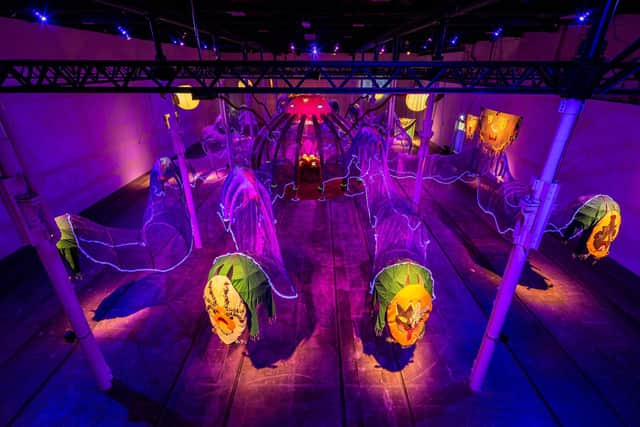
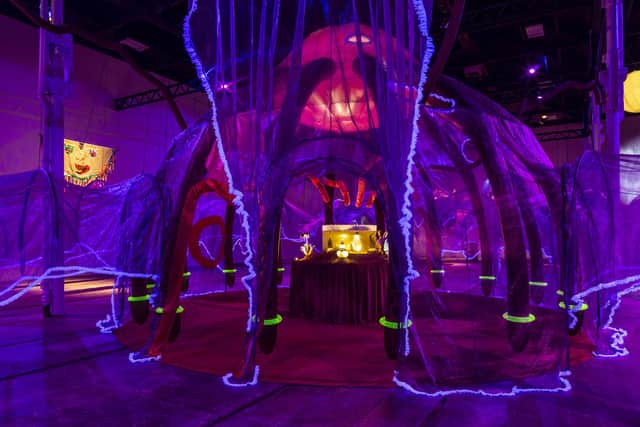
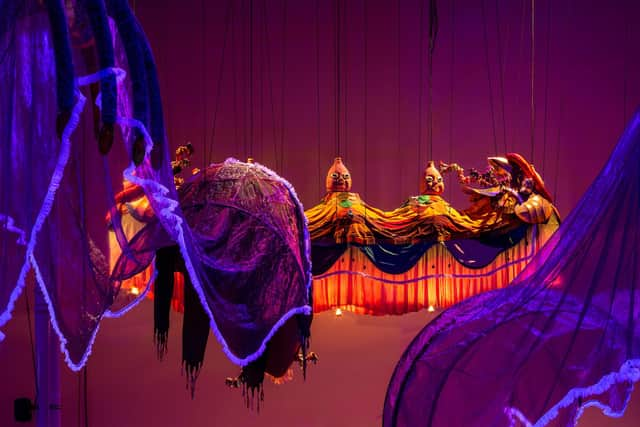
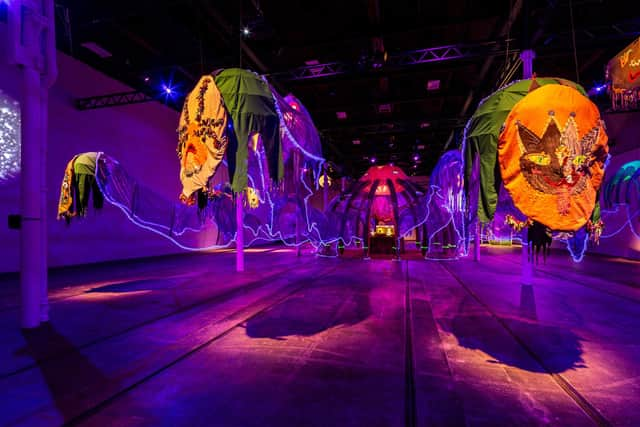
Tramway is not an easy space to transform, but Rae-Yen Song 宋瑞渊 has managed it. The artist has made the cavernous space into the domain of an immense, tentacled creature, further enhanced by subtly shifting coloured lighting and a throbbing, breathing soundscape.
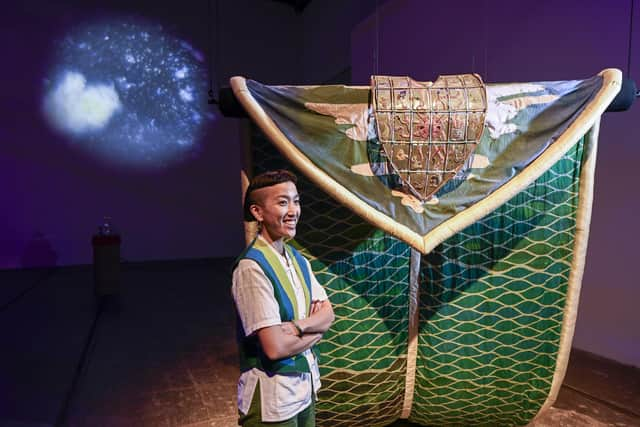

This is •~TUA~• 大眼 •~MAK~• (Song’s titles typically use symbols and Chinese and English characters). Arriving to give me a tour, Song (who doesn’t use personal pronouns) tells me cheerfully that Tua Mak is an ancestor, the artist’s mother’s sibling, who drowned in the ocean off Singapore in the 1950s at the age of 13. The show is Song’s way of getting closer to this story, a “fabulation” of Tua Mak’s life and death. “So, shall we walk through a tunnel?”
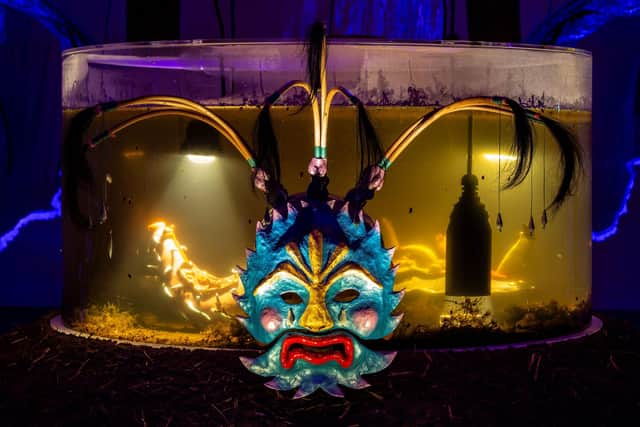
We walk down one of the tentacles and arrive in “the belly of the beast”, a carpeted shrine which houses Tua Mak’s qi – heart, energy, possibly brain – the Song family pond. Not a replica, you understand, the actual pond, carefully decanted from the Songs’ Edinburgh garden and now inside a glass tank.
We stop to peer into the depths for tiny critters, which are also important in this show. The pond’s ecosystem is livestreamed to screens on two walls, and, through a specially designed programme, partly controls the lighting and sound. The work is about the monumental and the microscopic, Song says, “about family, about relation with others and the more-than-human.”
When Song’s work first appeared at scale in 2021 in a solo exhibition at Dundee Contemporary Arts, I was immediately impressed by the ambition, the quality of making, and by the distinctiveness of the artist’s voice. By fusing elements of personal family history with Chinese mythology, Taoism and an interest in the more-than-human, Song has developed a creative language which brings together the micro and the macro, the mythic and the everyday.
Song says: “I guess I have a real respect for and want to show the sense of the micro and the macro, these tiny microscopic beings too small to see with the naked eye, which are actually so important. Things aren’t all done in big brushstrokes, it’s actually all about the granular detail of things that make up the bigger body, and how they support one another.”
Currently, as well as being shown at Tramway, Song’s work is in the Hayward Touring exhibition Material Worlds, and in the Wilson Gallery in Cheltenham. This year also brought the artist’s first solo show in London, at William Hine Gallery, and a prestigious commission for the Folkstone Triennial.
While adaptable to different scales, the work seems to blossom in big spaces, the bigger the better. “I find big spaces exciting because of their potential,” Song says. “I think Tramway allowed me – whether it’s a good thing or not! – just to get bigger and bigger, and really fill the space with ideas and energy. I’m actually more apprehensive about rooms.”
The artist, 32, who is Scottish-born Chinese-Singaporean, grew up in Edinburgh, always drawing, always inventing worlds. “I’ve always just played. As a kid, I always played imaginary games – and to an embarrassing age,” Song laughs. “When I reflect on that now, I think, wow, I’m actually still doing that. I think that sense of play is vital to what I do.
“I think of myself now predominantly as a maker, a maker of things, but also I really like to make things happen. I’m not really interested in making art objects, I’m more interested in making art that is of real life and can be used, like a vessel, a costume or an instrument. Rather than it being a static object, everything is an event.”
Song describes how the sandmason worm sculptural costume she made for Folkstone was worn by five family members at the Tramway opening, and the other costumes in the current show will be used for an opera about Tua Mak’s story, to be staged at Tramway for Glasgow International in June.
This huge installation, much of which is handmade, is, Song says, the work of “many materials, many hands, many collaborations”. As well as the help of “studio friends”, there were the Song parents, who travelled weekly to Glasgow by bus to help, a team of specialists including animators and a sound artist, and Song’s partner Michael Barr.
“He is officially the producer in my practice, but I would say he’s like an engineer to the way I think. I have so many ideas, there’s an abundance of ideas which are both very bad and very good, and it’s then about filtering and an engineering of how to make something exist.”
Song graduated from Glasgow School of Art in 2014, the year of the first Mackintosh Building fire. Running late for the degree show, the artist’s “bird-like chimerical figure” was never actually installed in its place above the staircase in the Mackintosh Gallery. In the extra time the students were allowed by the Phoenix Bursaries, Song set up Yaka Collective with six fellow students on the Sculpture and Environmental Art course. By helping each other, they learned how many hands could extend the ambition of their work.
For the grassroots Glasgow Open House Festival in 2017, Song collaborated with family members for the first time, processing a “sculptural palenquin” from Song’s Bridgeton studio to the Lauriston Arches. “Looking back that was a real beginning of how my work is, and how I think about my work.
“I’m so blessed to have a family who are happy to do all the ridiculous things I’ve asked them to,” Song laughs. “This has become an ongoing collaboration and an ongoing performative series that allows me to think about growing up in Edinburgh, about us being immigrants in Scotland and what that means to take up that space. More crucially, to me, it’s a way to bring my family into what I do – it’s their stories, too.”
After taking part in the Talbot Rice Gallery’s Residents Programme for early-career artists in 2019-21, Song was invited to make a solo show at DCA, offering the potential to transform a large space for the first time. The work was another room-sized fabulous creature, also inspired by an ancestor, Song’s maternal grandfather.
“That was a big moment, the first time I was able to think about these ideas of embodying a space, of what architecture could be. I guess the curator, Eoin Dara, recognised something in the work, knew I could explode a bit – and I did!”
Song has come to understand the work as a connected act of world-building: everything is “entangled”, characters recur, sculptures become costumes and vice versa, nothing is wasted. “I think at the heart of it is a long-term exercise of world-making, and a world is not made by one, it’s made by a multitude of natures.
“Maybe in a sense working in that way, I’m believing in the things I make and wanting them to exist in multitudes. Maybe, at the heart of it, that’s what I want to be too, I want to exist in multitudes.”
Rae-Yen Song 宋瑞渊: •~TUA~• 大眼 •~MAK~• is at Tramway, Glasgow until 16 August
The Scotsman’s arts newsletter is now sent twice a week - subscribe today
Want the latest Scottish headlines sent directly to your phone? Sign up to our new WhatsApp channel here.
Comments
Want to join the conversation? Please or to comment on this article.