
Joseph Noel Paton, Dunfermline review ‘much more than just another Victorian painter’
This carefully curated exhibition sheds new light on the work of Joseph Noel Paton by offering a fuller understanding of his private life, writes Duncan Macmillan


Joseph Noel Paton: An Artist’s Life, Carnegie Library and Galleries, Dunfermline ★★★★★
Joseph Noel Paton was born in Dunfermline in 1821. Knighted and made Queen’s Limner in Scotland by Queen Victoria, with whom he was evidently on friendly terms, he was a celebrated and very popular painter. One of his pictures on show in Bristol attracted more than 50,000 visitors. This exhibition was planned for his bicentenary. Events intervened. It missed its appointed date, but has now finally opened. Carefully selected and thoughtfully hung and labelled by the gallery’s solo curator, Lesley-Anne Lettice, with support and significant loans from the artist’s descendants, the exhibition makes a very good case for Paton as much more than just another Victorian painter, mostly forgotten and rightly so.
With a family of 11 children to support, for all his success, it seems the need to make money was sometimes the driver for long hours in the studio and his work is uneven. Paton called his army of children “the Infantry”, however, and was devoted to them. Photographs show him as a typical bearded Victorian sage, but his family life suggests a much more attractive person than that stereotype. He drew his children constantly and they regularly posed for his paintings too. Most poignant among the drawings are two of his youngest boy, Malcolm Campbell Paton, called Callie. The first, done on holiday in August 1879, shows a pretty blonde boy. In the second, done in September, he is on his death bed, struck down by diphtheria aged only five.
The sense of Paton’s private personality also illuminates the more substantial works here. His father was a designer in the linen industry and Paton at first followed him as a designer in Paisley. He then went south to study. The most enduring legacy of this was his friendship with John Everett Millais. Millais became one of the leading Pre-Raphaelites and of all his contemporaries in Scotland, Paton was closest to the celebrated English group. This is seen in his choice of symbolic subject matter, period costume and detail, and also his miraculous observation.

The Lullaby from 1861-2, a woman with a little child sleeping on her knee, one of the loveliest pictures here, is also the most Pre-Raphaelite. The woman is playing the lullaby on an organ, its pipes supported by carved wooden angels. The composition suggests Holman Hunt’s The Awakening Conscience and the Gothic organ, patriotically, the 15th-century Trinity College altarpiece. The picture’s mood and atmosphere are quite Paton’s own, however. The woman is his wife Maggie and the sleeping child his eldest son Diarmid. If an organ is an improbable instrument for a lullaby, the observation is nevertheless exquisite and the mood in the picture enchantingly tender. With a nod to Van Eyck’s self-portrait in the mirror in the Arnolfini wedding, Paton has included himself in the picture, too. A tiny self-portrait is reflected in his wife’s gold earring.
Perhaps also inspired by the Pre-Raphaelites, Paton clearly endeavoured to find new religious subjects. Satan Watching the Sleep of Christ here is relatively straight forward, barring what looks like a gas-ring on Satan’s head serving as his flaming crown, but others, like Ezekiel’s Vision of the Dry Bones, also here, are pretty bizarre. They were also very successful however. When Ezekiel was exhibited in Edinburgh, 30,000 people saw it.

Paton is best known, however, for two fairy paintings, The Quarrel and Reconciliation of Oberon and Titania from A Midsummer Night’s Dream in the National Gallery. From his childhood in a house in Wooer’s Alley, a piece of wilderness within Dunfermline, he had a thing about fairies, it seems. (An engraving of his painting Fact and Fancy shows a little boy meeting the fairies in that same setting.)
His two major fairy paintings were to have been in this show, but instead now occupy a prime position in the new Scottish wing of the NGS. The first study for the Quarrel is included here, however, and in sketchier form some of the detail seems even more overtly erotic than in the finished picture. Fairies had licence, it seems.
A strange drawing of a girl with hypnotic eyes and a crowd of cupids raising her skirts does suggest that the erotic was not accidental. Relevant moral dilemmas do also feature. In The Choice, for example, a knight is torn between an angel and the charms of a bare-bosomed young lady. The problem in this case was practical too. The artist tried to capture the “exalted and joyous enthusiasm” on the knight’s face, but the poor girl posing for the knight “fainted on day two.” He tackled a more profound moral struggle in Luther at Erfurt, beautifully painted and crowded with period detail, as the great Reformer struggles to find the truth.
Paton’s other major fairy painting, The Fairy Raid; Carrying off a Changeling, is a picture of exquisitely observed moonlight. Although the moon itself is hidden by a tree, it lights up the fields and a group of standing stones as the fairies ride out of a dark wood into its light. The fairy queen has a wide-eyed, frightened baby on her knee and so the picture captures something of the sinister character of the old Gaelic fairies, the Sith. It was exhibited at Balmoral by royal command, but for all its sinister overtones, it was also a family picture. The label quotes the painter’s daughter pointing out herself and her brothers. “That’s Dummy, she says”, (Diarmid, the little blonde boy on the left), “that’s Freddy (the baby in Titania’s arms) and that’s me, and we are all scuddy-buddy (naked).”
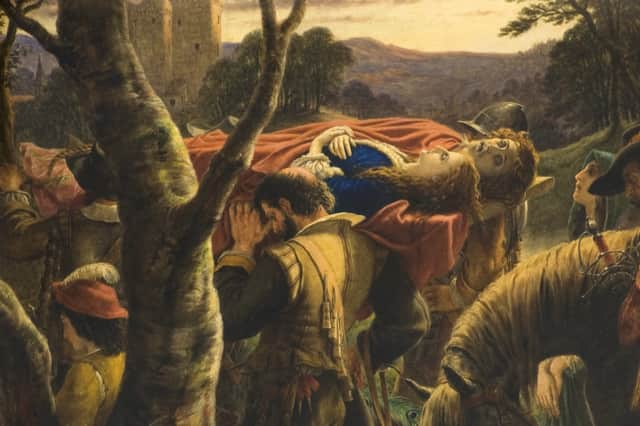
Paton’s maternal great-grandfather had been in the Jacobite rising of 1715 and his great-uncles had fought at Culloden. He was a passionate Scot and Scottish history and poetry were favourite subjects for him. The painting of the Dowie Den’s o’Yarrow, for example, is a beautiful illustration of a tragic ballad. The composition was also used in the artist’s illustrations to William Aytoun’s Lays of the Scottish Cavaliers. (Paton’s book illustrations and numerous published engravings of his work are a small side exhibition here.)
Scottish history and, too, the history of Dunfermline are the subject of Queen Margaret and Malcolm Canmore. Perhaps set in what is now Pittencrieff Park, the queen expounds the gospel to her as yet still uncouth husband. The picture At Bay suggests Jacobite history. It is a close-up of two Highland warriors perhaps fleeing from Culloden. The picture may, however, also be a double portrait of Paton and his brother Waller, also a gifted artist (their sister Amelia was an equally gifted sculptor) and so puts the brothers and perhaps the family firmly in the Jacobite tradition.
In keeping with these patriotic sentiments, Paton’s lifelong ambition was to create suitably grand monuments for the great Scottish heroes, Wallace and Bruce. His plans were never realised, but he was able to commemorate them in the great west window he designed for Dunfermline Abbey, a commission from Andrew Carnegie. There are a number of studies here for the four lancets, one each for Wallace, Bruce, Malcom and Margaret. Carnegie evidently took a direct interest and was greatly pleased with the result. Paton’s second window for the abbey was the Last Supper. It was not completed till after his death, but the full-size cartoons for the glass have been restored and are a major feature of this remarkable exhibition.
Joseph Noel Paton: An Artist’s Life is at Carnegie Library and Galleries, Dunfermline, until 9 February
Comments
Want to join the conversation? Please or to comment on this article.