
Claudia Martínez Garay, Dundee review: 'a show to puzzle over'


Claudia Martínez Garay’s solo show at DCA invites us to find our own path through an intricate web of images, writes Susan Mansfield
Claudia Martínez Garay: Every seed is awakened, DCA ★★★★
Anya Gallaccio: Stroke, 18 High Street, Paisley ★★★
Futureproof 2024, Street Level Photoworks, Glasgow ★★★★
The history and mythology of Peru, the impact of colonialism and more recent radical politics are all rich seams for Peruvian contemporary artist Claudia Martínez Garay, presenting her work in Scotland for the first time at DCA. The show is a reminder of the power of using very specific references and also of its danger: that the viewer feels perpetually on the outside, trying to crack the code.
Martínez Garay’s colourful tufted wall-hangings are highly pictorial and full of specifics: bird and flower species, chillis and seed pods, a llama, a jaguar, an adze. Then there are other images which look more symbolic: entwined snakes, the clenched fist of political resistance, the Virgin Mary. Working with a very helpful gallery assistant, we further identified a traditional Andean coffin, the stepped Chakana Cross and the Milky Way. As well as delving into Andean cosmology - some of it so old it is not only pre-Christopher Columbus but pre-Incan - the artist creates an eclectic visual language spanning many centuries.
A new mural for DCA, Hold Everything Dear, in part built from sublimation prints on aluminium, comes from a strand of work in which Martínez Garay explores the treatment of women under the colonisers. The inspiration was a drawing of a woman being punished for adultery, part of an illustrated text by Peruvian nobleman Felipe Guaman Poma de Ayala which was sent to Spain to denounce the behaviour of the conquistadors. It features objects suspended by rope, which echoes the decoration of the Yunza ritual found in Peruvian carnivals.
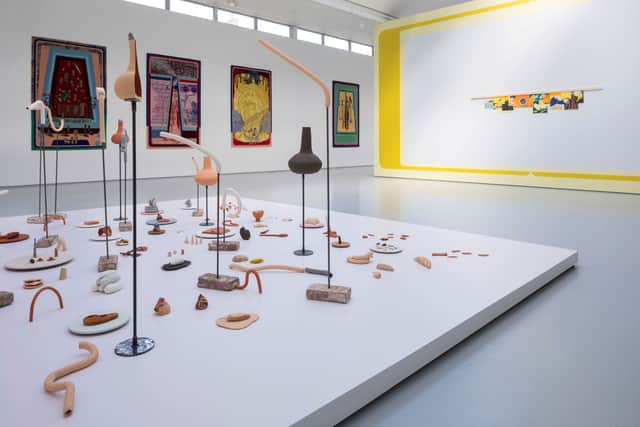
In the smaller main gallery, she turns to more recent history with Ayataki: Song for the Dead (2022-23), a video animation which explores the aftermath of the conflict between The Shining Path and the military in the 1980s which led to forced disappearances and mass displacement. With electronic music created by the artist, which also has sampled sounds and snippets of speech, it works by brief flashes of illumination. A scatter of chairs like the aftermath of a secret meeting, or the ruined shell of a house, are suddenly, briefly lit. Fires burn on a hillside. A muffled voice says “my whole house is lost”. The whole thing flickers with instability and dread.
Martínez Garay’s first training was in printmaking, and a new group of risograph prints made in the workshop at DCA and arranged like an Andean Chakana Cross addresses colonial exploitation more directly, while another explores images of sunrise and sunset in anti-fascist propaganda from around the world. A sculptural installation from 2018 is a tongue-in-cheek look at how Western museums have collected and displayed artefacts from other cultures, failing to discriminate between the significant, the symbolic and the everyday.
It’s a substantial show, but it needs time and must be puzzled over. The invitation seems to be to find one’s own path through the interconnecting web of images from the past which are spun into a kind of eternal present. What must be overcome is the sense that too much is still eluding you.
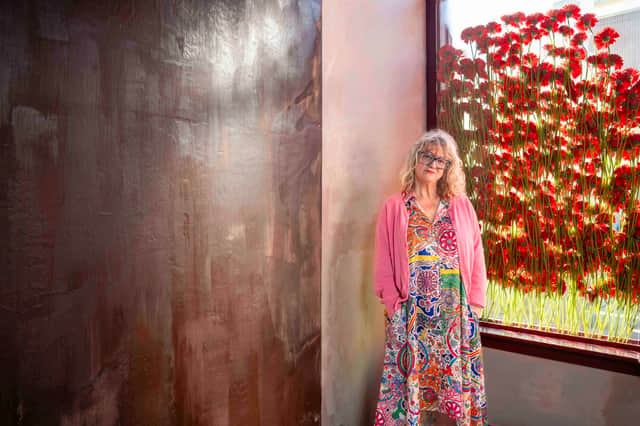
By contrast, Stroke, Anya Gallaccio’s installation in an unoccupied shop in Paisley’s High Street does the opposite: it presents the viewer with one thing, a room the entirety of which is coated with chocolate. Gallaccio was born in Paisley and the show has been organised by JUPITER+, the outreach programme from Jupiter Artland, and supported by Future Paisley, the town’s cultural regeneration programme. A series of outreach events and education acitivities runs alongside.
Stroke is a multi-sensory experience, as much about smell as sight. It has been made in various places - including in Vienna and, in 2014, at Jupiter Artland. Here, the smooth chocolate-coated walls contrast with the derelict interior of peeling wallpaper and cobwebs. Like many of Gallaccio’s works, the impact is in the process of decay: in the first week, the material was already starting to “bloom” where the sun was strongest. By December, it won’t be pretty. In one of the windows, three hundred gerberas of a variety called Preserve Beauty are on the same trajectory.
Gallaccio has just won the commission for the Aids Memorial in London and is the subject of a major survey at Turner Contemporary in Margate. To have her work on Paisley High Street can only be a good thing, and will doubtless be a talking point. Part of Stroke’s impact is in people’s reaction to it. A large part, in fact. It’s about decay and decadence, attraction, revulsion, but by the time you’ve covered those bases there isn’t much to add.
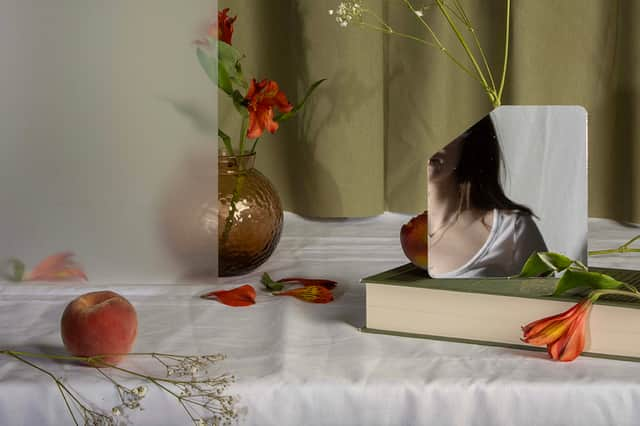
Meanwhile, Street Level Photoworks presents Futureproof, its annual showcase of new graduates working in photography chosen from degree shows from Scottish art schools and further education colleges. It’s an impressive collection of 23 graduates, thoughtfully installed so that similar works can begin to talk to one another.
It’s packed with skill and inventiveness. Coral Allen explores her Jamaican family history, linking their stories to the music of reggae and screenprinting family photographs on a wooden mount which looks like a giant record - the only thing missing is the soundtrack. Caitlin Eadie prints cyantopes of women on mirrors and mirrored metal, giving them a soft, elegiac quality, while Naomi Wood creates beautiful still lifes with a fragment of portrait captured on a mirror.
Demelza Kingston captures plants and gardens in a variety of analogue processes; Clarissa Gurd traces the impact of minerals from former coal mines leeching into the South Esk, and Rachael Clarkson looks at endangered landscapes in a triptych of photographs which seem themselves to be deteriorating.
Heather Graham makes striking images inside abandoned flats in Clune Park, Port Glasgow, turning fire damage into a kind of dramatic, luscious decay. Chema Rodriguez Alcantara’s degree show was inspired by the site of a former brickworks in Glasgow. Here, large format photographs are partnered with mosaics of found metal and broken pottery, taking a step away from the specific context towards the qualities evoked by the materials themselves. Both Marylynn Ballard and Victoria Filimonova deal with Scotland’s witch trials, working with atmosphere and fragments of history.
Others take a more straightforward documentary approach: Charles McGuigan makes excellent monochrome portraits of residents of the Raploch in Ordinary Lives, Extraordinary People, and Rob Symington’s black and white images of Prestwick and Ayr in Where I Used to Live use the specific to capture the universal, the challenges faced by towns almost everywhere.
Claudia Martínez Garay: Every seed is awakened runs until 17 November; Anya Gallaccio: Stroke until 31 December; Futureproof 2024 until 3 November
Comments
Want to join the conversation? Please or to comment on this article.