
Barbara Rae on her Antarctic art: 'I feel the presence of Shackleton and the whalers'
Dame Barbara Rae tells Mike Wade what she’ll be looking out for next month when she sets out once again for the Antarctic
Sailing down the Beagle Channel away from Tierra del Fuego towards Antarctica, the artist Dame Barbara Rae never thought for a moment that the purpose of her expedition was “to see bloody penguins”.
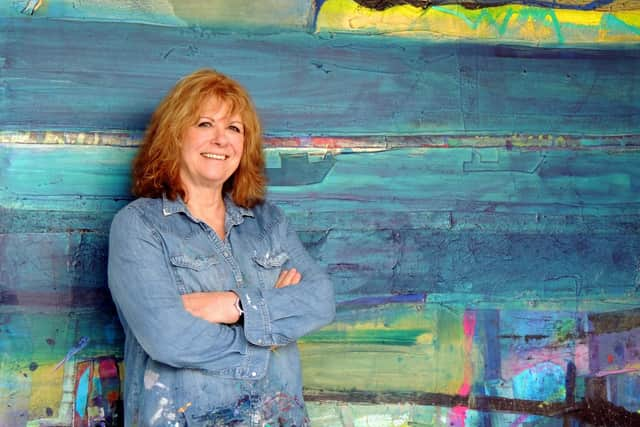

Yet here she is, almost two years later, safely ensconced in Edinburgh’s Royal Scottish Academy building, scrolling through images on her mobile phone, seeking out pictures she has made from photographs she took of the birds.
“One of my friends saw the photographs and said, ‘I know someone who’d really like a penguin picture for her birthday,’” Rae chuckles. “I said, ‘No!’, but then I started doing these three foot by three foot canvases, based on the penguins.
“They’re not… “ she pauses, hunting for the word… “whimsical. They are much more seriously connected with the landscape.”
The image she shows off is an extraordinary thing – a 1950s map of South Georgia is printed over the bird’s white breast, a craggy, forbidding landscape behind it, the darkness offset by the vivid blues of glacier meltwaters.
She has finished at least eight penguin paintings like this, among 100 works, created in her studio after her first trip to Antarctica aboard the cruise ship Island Sky. She begins a second voyage there in February, so she will have many more works to select from before Charting South, a show based on her travels, opens at the RSA in November.
After travelling four times to the Arctic from 2015 to create her powerful show, The North West Passage, Antarctica became an inspiration for the 82-year-old artist, against, it seems, her own expectations.
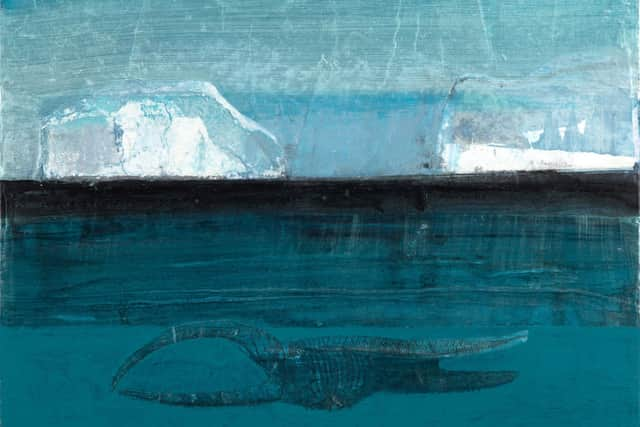
On her website the text is explicit: “[Rae] is not interested in topography. Her point of departure is the history of a place and its people. Abstract expressionist themes are given maximum intensity… she distils the presence of mankind.”
Contemplating Antarctica, she says, “I set off thinking, I'm going to see a pile of ice and mountains – I thought, there’s no people there, no history – what am I going to be interested in?”
Two extraordinary human stories, etched onto the icy landscape, transformed her understanding.
The first of these was the epic struggle more than a century ago of Sir Ernest Shackleton and his crew after their ship, The Endurance, was crushed and sank in the ice. After drifting for six months on pack ice from October 1916, the 28-strong crew braved a five-day voyage in small boats through mountainous, icy seas to Elephant Island. Then Shackleton himself led a party of six, in the James Caird lifeboat, on a perilous 800-mile voyage to King Haakon Bay, on the uninhabited south coast of South Georgia.
It would take another 36-hour trek overland through unmapped, mountainous wilderness before Shackleton reached the whaling station at Stromness, and began to organise a rescue mission for the remaining crew on Elephant Island. Ultimately, all the men were saved.

“It took us two and a half days to sail between Elephant Island and South Georgia,” recalls Rae. “It took Shackleton 16 or 17 days, and they set sail with no idea they would ever reach their destination.”
The struggle between humanity and brutal nature was “off the scale” and to see old photos of Shackleton and his men in their Burberry outfits seems almost absurd to the artist. “How did they do that? I get cold walking out there,” she says, gesturing at the teeming rain, beyond the windows of the RSA building.
Original photographs by Frank Hurley have inspired her, and some of the most evocative works she has so far created incorporate his images. Rae is hopeful she will not be prevented by copyright rules from exhibiting these pieces, which combine collage and monotype printing, the painterly printing technique which is such a feature of her output.
“This is them leaving Elephant Island,” she says, holding up a copy of another of her paintings. “The photographs are printed onto very fine Japanese paper; I collage that onto the paper on which I’m doing the monotype, then overprint the inks.
“It's difficult using collage on a larger scale because the paper is very fragile, and when it becomes wet it can disintegrate. So, you've got to have the technique to get it on the canvas. But I’m having great fun with these – I’ll be devastated if I can’t use them.”
The other inspiration from the Antarctic is the history of European whaling that for most of the last century brought sailors and hunters from Scotland and Norway into this inhospitable place. Some of the most emotive sights witnessed by Rae were the rusting hulks of old whaling vessels in Grytviken harbour, South Georgia, and the iron skeletons of dilapidated buildings and old whale oil tanks. Deception Island, crescent-shaped and formed from a volcanic crater, was even more evocative.
“You’ve got to fall in love with it just for its name,” says Rae. Deception was abandoned by Norwegian whalers in the 1930s, was a British base during the Second World War, and became the site of one of the earliest research stations in Antarctica. The detritus left behind by humanity has added layers of meaning to the site.
“There were ‘ice’ boats [small boats which supplied ice for fresh water to whaling vessels] that look almost like [Shackleton’s] James Caird, strewn on the beach, all in various states of disintegration. The wood was weathered to a pale white,” she recalls. She painted them? “Oh yes, they were my favourite thing. I have done a whole series based on them.”
Rae, born in Falkirk and a graduate of Edinburgh College of Art, has for decades been a vital figure in contemporary Scottish art, a former teacher who has influenced generations of painters.
“I learned so much, even in primary school during my teaching practice, because you have to understand how you are doing a painting, and what a painting consists of, if you are going to teach others,” she says.
She taught at Aberdeen College of Education, before moving to Glasgow School of Art. There, working alongside artists and fellow teachers such as David Donaldson, Geoff Squire and Sandy Moffatt, she helped nurture some extraordinary talents, not least the “New Glasgow Boys”, Steven Campbell, Ken Currie, Peter Howson and Adrian Wisniewski.
Of them all, she recalls Currie with most affection. “Ken was absolutely brilliant. You could say to him before the weekend, ‘Come back with some new stuff on Monday,’ and he’d turn up with a mountain of things – he’d go into sidings and paint railway carriages. He was just unbelievable.”
Decades later, she was working in Glasgow Print Studio, and she noticed a clean-cut, balding chap shyly smiling at her. He said: “Don’t you recognise me? ‘I’m Ken Currie.’” Rae recalls: “I said, ‘Ken, the last time I saw you, you had hair like Daniel Day-Lewis in The Last of the Mohicans!’ His hair was down here,” she indicates a place somewhere south of her waistline. “He’s a great guy and a fantastic artist.”
Friends have sometimes urged her to go to India to paint, and tell her “You’d love it.”
“I wouldn’t love it,” she retorts, as if someone has just made the suggestion again. “I can’t just dip in and dip out, and do a bit of flash painting, without knowing what I’m on about.
“I’ve got to feel it. Going on this next trip to Antarctica, I’ll be so much more aware of the history and the significance of what happened there. These are the important things. I’ll feel the presence of Shackleton and the whalers.”
Barbara Rae: Charting South is at the Royal Scottish Academy, Edinburgh, from 21 November until 24 January 2027. This feature was produced in association with the RSA
The Scotsman’s arts newsletter is now sent twice a week - subscribe today
Want the latest Scottish headlines sent directly to your phone? Sign up to our new WhatsApp channel here
Comments
Want to join the conversation? Please or to comment on this article.