
Art reviews: Toby Paterson | Alfred Buckham | Adrian Wiszniewski | Lachlan Goudie
Inspired by modernist architecture, Toby Paterson’s exhibition at the Royal Scottish Academy is like a requiem for a utopia that never was, writes Duncan Macmillan
Toby Paterson: A Short Guide to Towns Without a Past, Royal Scottish Academy, Edinburgh ★★★★
Alfred Buckham: Daredevil Photographer, Scottish National Portrait Gallery, Edinburgh, ★★★★★
Adrian Wiszniewski: Paintings for the Front Room, Open Eye Gallery, Edinburgh ★★★★
Lachlan Goudie: Tools of the Trade, The Scottish Gallery, Edinburgh ★★★★
Currently showing in the Academicians’ Gallery at the RSA, Toby Paterson is an abstract artist. He uses flat colours with clearly defined, although not strictly geometrical shapes. There are also often elements of relief. Over Marin, for instance, is a black square with a big blue shape entering from above, a small white rectangle entering lower right, a yellow circular shape hovering at one side and two slim bars of aluminium-like drawing crossing the blue. It is very elegant. Post Office and Serpentine are composed of similar elements. Other works are rather sterner. North Avenue, for instance, or Painting for a Staffordshire Blue Engineering Brick Wall both have the rectangular formality associated with de Stijl in the 1930s.


Commercial Landscape (Imprimerie Moderne), however, is a picture of an actual building rendered as a semi-abstract composition, while Turquoise Bricolage (My War), Built Colour Bricolage, Canning Town and others are all collages of elements of buildings unified by screenprinting or some similar process. The artist’s preoccupation with architecture is apparent, but these are nevertheless clearly independent works of art, many of them really beautiful. Reflecting his interest in the lived environment, ten of the works are hung on one long wall and part of an adjacent wall which are in turn painted with a big composition in black, yellow, terracotta and sky blue.
Paterson’s title for his show, A Short Guide to Towns Without a Past, is borrowed from an essay by Albert Camus about three Algerian towns, Algiers, Oran and Constantine, and the link with the existentialist Camus does perhaps throw light on the artist’s work. As you might expect from Camus, his essay with its express focus on the lived moment is existentialist in flavour. What seems to inspire Paterson is living in cities — especially his native Glasgow— and, all witnessed in the existential moment, their rise and fall, their mix of vision, accident and failure and the frequent loss of their past through demolition in the name of development, of a future that is always uncertain.

Much softened, the austerity and foreignness of pre-war modernism was made respectable in the UK by the Festival of Britain. Elements of this style are often echoed in Paterson’s work reflecting how it was adopted by architects as they set out to rebuild the country as a modernist utopia from the ruins of war. Their ambitions, however, eventually involved the ruin of some cities that were not actually bombed and some of what was done then, while a still unfulfilled dream, is now in ruins in turn.
Paterson clearly sympathises with the vision of these architects, but is equally conscious of how far it failed in the realisation. Here Tracoba, for instance, is a tiny image in a big field of a visionary housing scheme that, built with too cheap materials, proved disastrous. Likewise Unfolding Premonition, composed of elements of a building laid out like a model-maker’s plan, refers to Elmbank Gardens, an ambitious, mid-70s development at Glasgow’s Charing Cross that the artist remarks he has known all his life, but whose now imminent demise is the premonition in the title.
The inspiration for Turquoise Bricolage (My War) is the Anderston Centre, a modernist mega-centre that was named after Anderston Cross, a district obliterated by Glasgow’s motorways. Ironically, the Anderston Centre itself is now partly destroyed in turn. Twice obliterated, a city might well find itself without a past. Paterson certainly admires some of the architects whose often still incomplete dreams are now turned to dust like this, a long drawn out Shakespearean tragedy, the inevitable victory of brute reality over visionary idealism. Talking to him he has no illusions about how catastrophic much of this has been, but at the same time he celebrates the idealism that drove it. His show is like a requiem for a utopia that never was.

Pioneer aerial photographer Alfred Buckham’s photograph of Edinburgh from the sky with an aeroplane soaring against a dramatic cloudscape is a familiar icon of the city. In the new show of his work at the Scottish National Portrait Gallery there is an equally dramatic picture of London as well as pictures of St Andrews, Oxford, Durham and other ancient British cities, but the show demonstrates that there was was a lot more to Buckham than these cityscapes.
A trained photographer, he served in aerial reconnaissance during the First World War, stationed at Turnhouse. Flying was a risky business. He crashed eight times and walked away, but because of an injury on the ninth crash he lost his larynx. Thereafter voiceless, he had to breathe through a tube. Undeterred, he continued his career after the war. His camera was bulky as it used glass plates, but he always took his photographs standing up in an open cockpit with —for security — one leg tied to the aircraft’s seat. He also edited his pictures extensively, working directly on the negatives and usually combining several in a single picture.
He had a library of cloudscapes which he matched with the light on the ground to improve the drama where needed, as indeed he did in his celebrated picture of Edinburgh. He had a library of aircraft pictures too, all taken on or from the ground, and always added them to the sky for scale. This aeroplane motif became like a signature. He also worked directly on the final print, even experimenting with applied colour in a dramatic picture of a battleship in front of the Forth Bridge. The bridge itself was a favourite motif, too.
After the war, Buckham flew across Mexico, South America and the Andes with a magazine commission. Flying at nearly 20,000 feet to photograph volcanoes and snowy mountains with a tube in his throat to breathe, he coolly expected to pass out. (The pilot evidently had oxygen.) The result of his courageous flying is a series of extraordinary pictures of soaring, snowy peaks and the smoking crater of Popocatépetl. He was indeed an artist.
According to a note on the exhibition, Adrian Wiszniewski’s inspiration for Paintings for the Front Room at the Open Eye Gallery was the recent uncovering at Pompeii of what might have been a Roman front room. It is a piece of historical continuity that clearly intrigued him and indeed the pictures are of a variety of his familiar characters engaged in leisurely activities suitable for a front room, building houses of cards, talking on the phone, or just hanging out, all painted with the artist’s usual clarity and vigour.
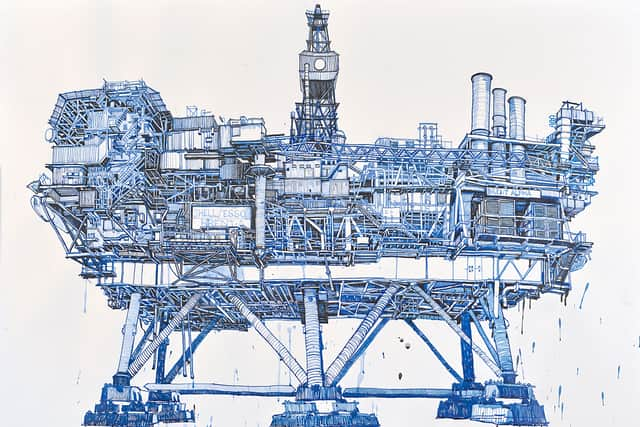
These are the characteristics of Lachlan Goudie’s work in Tools of the Trade at the Scottish Gallery, too. In a series of paintings and also of very large and powerful drawings, all done on site, he has recorded in shipyards, dockyards, steelworks and oil rigs, what survives of Scotland’s once great tradition of heavy industry. It is a remarkable achievement and, although not quite as daring as Alfred Buckam tied by one leg to the seat in an open cockpit, his close-up view of white hot steel in the rolling mill at Clydebridge must have been pretty demanding nevertheless.
Toby Paterson until 23 November; Alfred Buckham until 19 April; Adrian Wiszniewski until 15 November; Lachlan Goudie until 22 November
The Scotsman’s arts newsletter is now sent twice a week - subscribe today
Want the latest Scottish headlines sent directly to your phone? Sign up to our new WhatsApp channel here.
Comments
Want to join the conversation? Please or to comment on this article.