
Art reviews: The Thread That Pulls | Nature turns | Barbara Rae DBE: Prints
There’s an unusual twist in the new exhibition from Visual Arts Scotland, writes Duncan Macmillan
The Thread That Pulls, Royal Scottish Academy, Edinburgh ★★★★
Nature turns, Royal Scottish Academy, Edinburgh ★★★★
Barbara Rae DBE: Prints, Open Eye Gallery, Edinburgh ★★★★
Visual Arts Scotland (VAS) began life 101 years ago as Scottish Women Artists. With 420 works on view, the Society’s latest exhibition, The Thread that Pulls, presented in the RSA’s main galleries, is, we are told, its largest ever. The Society’s president Tavienne Bridgwater gives us a gloss on the title when she amplifies it to say: “The Thread That Pulls asks us to pay attention. These artists pull at the loose ends of our moment, revealing tensions, truths and possibilities that might otherwise remain unseen.” No harm in aspiration, but I am not quite sure if the show really manages all that. It is, as ever, diverse, however. There is also a slightly unusual twist in the hang which seems to have been done broadly by colour. The works in the big, central gallery tend to be whitish at one and and pinkish at the other, for instance. There is a gallery with predominately greenish works and another in which they are largely black and white, and with such a diverse show this arrangement actually helps to unify it a bit.


Diversity is indeed what generally distinguishes VAS from the other exhibiting societies. Unlike them it sets out to give space to crafts like tapestry, jewellery and often furniture, too. These things do seem a bit less prominent than usual, however, though that may be just because it is such a big show. It is also true that the boundaries between art forms are so blurred now that it is sometimes hard to tell what’s art and what’s craft. Roxy Russell’s Hanging by a Thread is a case in point. It is composed of hanging threads which suggests some remote link with tapestry, but these are then entangled with leaves and twigs.
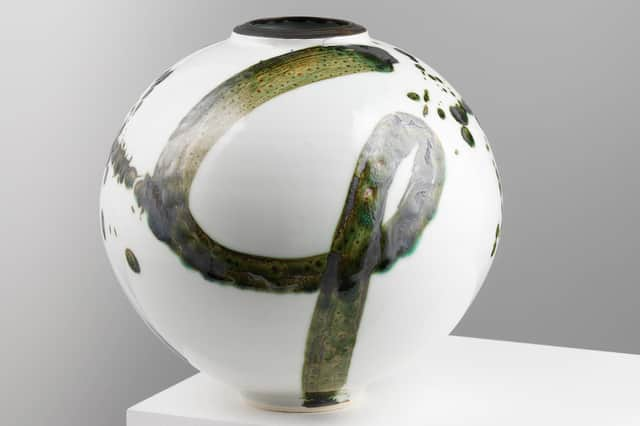
There are are, however, some intriguing items that do fall clearly into the category of craft. One of the most striking is a big tapestry, or strictly a knotted rug, by Vincent Deighan called The Laden Land, a medieval scene of dark goings-on with overtones of Hieronymus Bosch and perhaps, too, of Grayson Perry’s tapestries that hung here a year ago. It is nice too to see a delicate work by veteran weaver Joanne Soroka, titled Still I Rise, and there is maybe bit of Grayson Perry’s inspiration in Choose Your Own Adventure, Magnetic Pot, by Molly Kent. Some of the other ceramics, though, like Tricia Thorn’s Porcelain Moon Jar, for instance, Jo Gifford’s White Square, Layered, or Wei Lin’s Generative Blooming, leaf forms in celadon green, are simply beautiful.
Sarah Cleaver’s Adam, a seated boy within arms around his knees, is a beautiful piece of straightforward sculpture carried out in “cold cast iron”, an intriguing mix of iron and resin with a brilliant black sheen. Iron, but thoroughly rusted is Jagoda Zwiernik’s medium in her Cast of Potatoes and Shopping Bag. Lisa O’Brien’s medium in Force 6, November, appears to be rain which has been allowed to fall on wet ink. The result is a dramatic black blob. If her title, Force 6, suggests wind, Janette Kerr’s wild, Can you hear it, can you feel it #1 in charcoal and graphite seems intended actually to represent the wind and does so with some success. Rain is indirectly the subject in Joshua Miles’s Tree Dripples, too. It is a fine monotype of the little circles made by rain falling from trees onto water. Tear drops, not rain drops, are the theme of Amanda Airey’s A Year of Tears, an all over pattern of pink tear drops fill the sheet. Anupa Gardner’s woodcut Cool Waters is a more straightforward image of water, a pool reflecting the trees that stand around it. Trees are the subject of two fine black and white drawings of woodland by Blake Milteer and, too, of Liz Green’s Highland Cathedral- Remnant Mossy Oaks. Houses, however, are the subject of Gary Anderson’s bold townscape, Shadows of Dean and Stockaree.
Figurative work includes Henry Jabbour’s delicately beautiful etching The Hug, and Luke Vinnicombe’s comical Hoovering the Cat. Joyce Gunn Cairns’s Solidarity, a delicate oil of a woman and her cat, suggests a gentler and more mutual relationship. Nicola McInally’s rather beautiful painting Waken appears to be a picture of the dawn sky, but the gap between such a picture of the sky and pure abstraction is narrow. In spite of its title, Andrew Ledgerwood-Walker’s equally beautiful All the Pink Clouds is, for instance, really a colour-field painting, although a band of green at the bottom edge anchors it to landscape. Catherine Sargeant’s OFL Day 62 For a moment (the 62nd day in a sequence of 100) set out as painting of the sky, but that simple image was overtaken by a piece of text still recognisable in the cloud forms. Bella Grant’s beautiful Tranquil Time is just a lovely view out of a window of an evening sky and its reflection in water.

Altogether there is much to admire in VAS’s mammoth show, but if you are not exhausted, you can go downstairs to the RSA’s Nature turns. Its title indicates an intention to celebrate the winter solstice with pictures about winter, but really, if on a smaller scale, it too is a portmanteau show. The artists are all academicians, but some of those included like John Houston and Elizabeth Blackadder, are no longer with us. All the same, Houston is a bit of star here. Three of his watercolours, the sun over a calm sea, the moon in a dark sky, and a moonlit forest are really stunning. Victoria Crowe matches them, if in a more reflective mood, with a small painting of the Pentlands in snow and another of a tree seen against winter light. There is drama too in Eva Ullirch’s Glimmer, a monochrome image of sky and sea, and more reflective poetry in Susie Leiper’s two lovely small paintings in oil on wooden panels where the wood grain reads as mist or forest. Norman Macbeath’s photo of skeleton leaves is, like all his work, a magical homage to nature even if his title, Equinox, suggests a different season to the one that the show proposes to celebrate. Lennox Dunbar’s beautiful small painting Flow Country-Winter is however unambiguous about the season.

In a small selection of Barbara Rae’s prints at the Open Eye, her magnificent Glacier print may be a picture of the Arctic summer, but it is unambiguously a picture of ice. Sea Ice North West Passage is unambiguously icy, too. If the artist can find such colour and drama in a sea of ice, she also finds it in the Scottish winter as in Moorgate, a view looking into the Lammermuirs over a green gate and beneath dark winer sky. These really are dramatic and masterly prints.
The Thread That Pulls runs until 2 January; Nature turns until 18 January; Barbara Rae DBE: Prints until 20 December
The Scotsman’s arts newsletter is now sent twice a week - subscribe today
Want the latest Scottish headlines sent directly to your phone? Sign up to our new WhatsApp channel here.
Comments
Want to join the conversation? Please or to comment on this article.