
Art reviews: Still Glasgow | Views of Glasgow
Two new exhibitions invite us to consider both the huge social changes that swept Glasgow in the 20th century and their enduring legacy, writes Susan Mansfield
Still Glasgow, Gallery of Modern Art, Glasgow ★★★★
Views of Glasgow: A Window Into Communities, Hunterian Art Gallery, Glasgow ★★★
Glasgow has got to be the most photographed city in Scotland - at least, by professionals. As its name became a watchword for poverty and industrial decline, it seemed to become a magnet for photographers. In the 1960s and 1970s in particular, one imagines people with cameras tripping over one another to capture its grimy glory.


Still Glasgow, a collection of some 80 images largely drawn from the city’s own collection, is a thoughtful presentation of Glasgow through the lens. Reaching almost to the present day, though the major focus is on the pre-digital years, it sidesteps any overtones of poverty nostalgia or well-intentioned voyeurism, capturing a city of nuances as well as extremes.
The greatest hits are here, pictures like Bert Hardy’s The Gorbals Boys and Oscar Marzaroli’s The Castlemilk Boys, the towers of Basil Spence’s new Gorbals rising above blackened tenements (Marzaroli again). But they are not given prominence, and are shown next to work which is less familiar, foregrounding women photographers and non-white subjects: no mean city, yes, but one in which diversity is nothing new.

Marzaroli’s photographs of Joan Eardley and the Samson children in her Townhead studio are well known, as is the Gorbals work of Joseph McKenzie, and the work of ubiquitous Eric Watt, a schoolteacher who documented the city from the 1960s until the 1980s. His picture of the Coca-cola Roller at the Glasgow Garden Festival in 1988 will roll many back down memory lane.
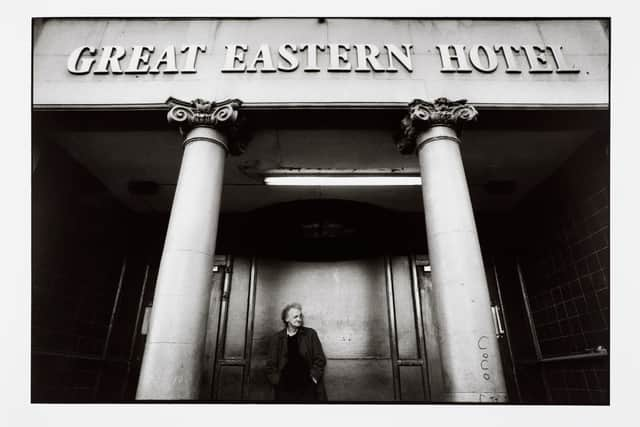
Keith Ingham was one of four photographers from Partick Camera Club invited by Elspeth King to help document the East End in the 1970s. But there are international names too: London-based documentary photographer Nick Danziger, American Larry Herman who came to photograph Clydeside in the mid 1970s, and Jane Evelyn Atwood, an American based in Paris who spent time documenting Glasgow’s Great Eastern Hotel in 1994 when it was a hostel for homeless men.
David Eustace’s Buskers series, created in the early 1990s before he set off to make his name in New York, is a revelation. Not exhibited since, these pictures embody many of the qualities of Eustace’s later work: clarity, poise, rich tonal variation, a kind of gravitas. The dreadlocked guitarist, the monoclyist and the bagpiper are so utterly real one wonders who they are and where they are today. Sadly, he doesn’t tell us their names.
Much of the more recent work is drawn from community projects: pictures by Roma young people in Govanhill, and the women of the Glendale Women’s Cafe in Pollokshields. A collage portrait of Red Road Court, created by Iseult Timmermans in collaboration with residents shortly before the flats were demolished in 2015, is a significant achievement, using the structure of the block itself to frame images of interiors and of its legendary views.
In the third and final room, the tone shifts. One wall tries to cover broader culture in a handful of images: music (Alan Dimmick’s portrait of Franz Ferdinand in The Captain’s Rest), sport (a Marzaroli picture of the 1965 Scottish Cup Final), politics (a May Day march by Eric Watt), but this feels superficial when any of the three could merit an exhibition of its own.
The rest of the room is more successful, turning the focus towards art, with Roddy Buchanan’s film Gobstopper, and the remnants of an early film project from 1975 by Elsa Stansfield and Madelon Hooykaas. The video is now lost, but the words and photographs suggest how ambitious and interesting it must have been. The show concludes with Joanne Tatham and Tom O’Sullivan’s portraits of Glasgow-based artists in their studios. While one understands their desire to draw attention away from the best known names, the decision not to name their subjects at all feels like a loss, nearly a decade on, and this sense can only grow.
Though there is a shift in the final room away from the raw energy of documentary photography to practices which are more art-based, Still Glasgow is a rich and ambitious overview of the city’s relationship with photography. While the subject is too big for any show to encompass completely, it offers much to enjoy and more than a few surprises.

One stand-out image from Still Glasgow is Eric Watt’s shoeless child captured in 1974, sticking her tongue out at the camera in front of a chalk-marked wall. She might have walked straight out of the painting by Joan Eardley, of a child still wielding her chalk having scratched her initials on a wall, which is one of the highlights of Views of Glasgow - A Window Into Communities at the Hunterian Gallery.
Another ambitious exhibition, this brings together rarely seen paintings from the Hunterian Collection (the Eardley has never been exhibited before), with more contemporary reflections on what community is in Glasgow today. The Hunterian worked with four co-curators from the nearby Woodlands area: Fouzia Zafar, Josie KO, Vicki Fleck and Sapna Agarwal.

The show attempts to cover a lot of ground, with the wall text doing a lot of heavy lifting around topics such as legacies of empire, immigration, race divisions, industrial decline and the environment, to name a few. The materials in the show range from paintings, photographs and film (including excerpts from documentaries from the National Library of Scotland) to community-made textiles and ceramics from the city’s now long gone potteries.
If one can put aside the sense of an immense box-ticking exercise and simply enjoy what’s here, the show has many treats to offer: the unseen Eardley, a wonderfully expressive painting of a gable end by Danny Ferguson from 1975, a moody painting of Belhaven Terrace by the young James Morrison, Graham Murray’s cityscape from Kelvin Bridge, which renders walls and rooftops as abstract shapes in soft tones.
In an inspired piece of curation, Eardley’s chalk-wielding child is placed next to Human Nature, a piece of commissioned graffiti by Conzo & Glöbel from the city’s Grateful Gallery. There are projects as diverse as Mitch Miller’s “dialectogram” of the Claypits, Hamilton Hill, and excerpts from the illustrated book, What Starts Here Stops Here: A Tale of Glasgow and the World by Babs Nicgriogair & Annabel Wright, which takes a fresh look at the city’s chequered past.
It was also a joy to see documentation about the work of Stella Reekie, a Church of Scotland deaconness who turned her home in Glasgow’s West End into an interfaith centre in the 1970s, welcoming new Glaswegians from around the world.
Beneath all of this - indeed beneath both exhibitions - is an underlying story of change. Between 1960 and 1980, Glasgow was the site of the biggest urban redevelopment in Europe, a massive project grounded in idealism and a desire to build for the future. With hindsight, we see its flawed ideals and terminal incompleteness, and can ponder the impacts, for good and ill, of so much change in such a short time.
The show, which is part of the Hunterian’s Power In Our Communities project, uses that as a framework to encourage audiences to think about the changes happening now, and what we might want to see in the future. But, as community engagement projects go, this punches far above its weight. I defy anyone to come away from it not having learned something they didn’t know, and having enjoyed doing so.
Still Glasgow runs until 13 June 2027; Views of Glasgow: A Window Into Communities until 26 April
The Scotsman’s arts newsletter is now sent twice a week - subscribe today
Want the latest Scottish headlines sent directly to your phone? Sign up to our new WhatsApp channel here.
Comments
Want to join the conversation? Please or to comment on this article.