
Art reviews: SSA Annual Exhibition | Modern Miniatures | The Print Show
This year’s SSA Annual Exhibition is a lively show that is diverse in imagery, scale and media, writes Duncan Macmillan
SSA 127th Annual Exhibition, Royal Scottish Academy, Edinburgh ★★★★
Modern Miniatures, Royal Scottish Academy, Edinburgh ★★★
The Print Show, the Fine Art Society, Edinburgh ★★★★
The Society of Scottish Artists’ Annual Exhibition is currently at the Royal Scottish Academy. It’s the 127th although the Society was founded in 1891, 135 years ago. With wars and other things there have been some gaps. The SSA was set up by the artists as an alternative to the RSA. It was evidently not an acrimonious split, but there can be no doubt that younger artists felt the RSA was too conservative while its attitude towards women artists was certainly backward. The genders were equal in the SSA from the start. In Europe the 1890s was the decade of secessions. In Munich in 1892, in Vienna in 1897 and in Berlin in 1899, progressive artists seceded from the old conservative academies. In fact some of the Scottish artists who formed the SSA had exhibited with notable success in Munich in 1890 so there was maybe a link. Nevertheless, as this is the RSA’s bicentenary, to illustrate the common ground and indeed membership between the two organisations works by the first president of the SSA, Robert Noble RSA, and two other early presidents who were also academicians, James Cadenhead and Robert Nisbet, have been put on display here.
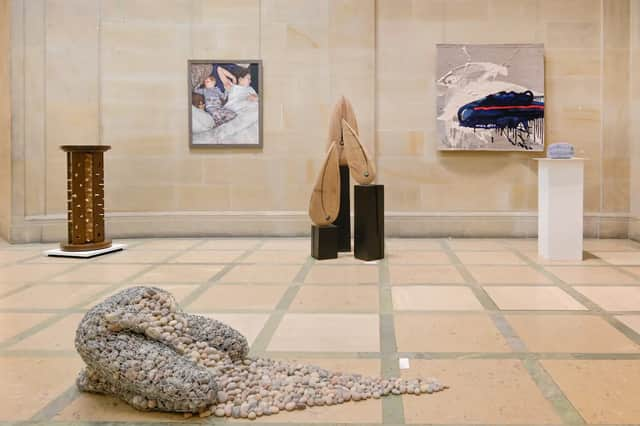

This year there were more than 2,000 works submitted to the show, but with room for little more than one in ten, selection clearly had to be pretty drastic. The result however is a lively show that is diverse in imagery, scale and indeed media for some of the methods deployed here do seem distinctly experimental. Susan Hotchkis’s Flake, for instance, which looks like something between geology and crushed metal, is apparently composed of screenprinted and embroidered textile. Tansy Lee Moir’s ghostly white Apparition is painted with a mix of charcoal and gesso on canvas. Ann Louise Kieran’s Dawnings (Exposures 1-240) is a collection of rather beautiful postcard sized landscapes drawn with a combination of ink and bleach, while Jayne Stokes’s Smithereens is a collection of pottery shards with minute images drawn on them in Indian ink.
The are other unusual drawing techniques here too. Laura Jane Bullock’s Dialectics of Division 1&2, for instance, are images of a curtained door in a brick wall apparently drawn with ink and fine lines of liquid plaster. This work’s exquisite minuteness is echoed elsewhere too. Denise Zygadlo’s Tulle 2 is a painstakingly precise pencil drawing of a length of netting, while Julia Ashe’s Lewisian Complex is a large, cloudy, abstract composition drawn entirely in fine liner. Even more painstaking is Carey Smith’s Sand, a composition on board of neat rows of hundreds of marble-sized balls of concrete ranging from white through grey to pink, the dots in printing rendered in concrete. Though clearly equally painstaking in execution, the sweeping rhythms of Mij Rothera’s Dip Pen drawing are rather beautiful.
Right at the other end of the scale is Divya Sharma’s In the Ruins We Remember. Described as a tapestry installation, it is a shaggy woven fabric draped over several stands and around 20 feet long. A lot of dangly bits include chains of cut-out letters, but nothing is legible.
Thread, though largely unwoven, is also the theme of Susan Pearson’s The Fates. With three chairs set out for the three Fates as they spin and snip, a glass door and a lot of thread and related apparatus, it suggests a cobwebby corner of Miss Havisham’s house. Kate Bell’s installation Moth Soup: a Reanimation Imagination, is rather similar. It includes an actual sewing table, a woven rug, two embroidery tambours and much else besides. Still on the theme of thread, Codie Ann’s QR Cod(i)e is a crocheted QR code which proved to be legible. More straightforward tapestry includes Joanne Soroka’s Continents and Fiona Hutchison’s Tide, with the broken surface of the latter emulating beautifully sea and sand. Elaine Wilson’s Blue Splash is the image of a dramatic piece of abstract painting rendered to fine effect in woven wool on cotton warp.
Alison Kinnaird is a long established master in the parallel craft of glass engraving and her Kite, as the title suggests, an image of a flying kite, is very beautiful. Deborah Boyd White achieves a similar effect in her Fragilepaperporcelain, somehow a delicate compound of paper and porcelain. Pottery is also a theme in two bizarre table settings. Millie Stewart’s Hello Friend is composed of several stuffed figures gathered round a table set with hostile-looking spiked crockery and Madeleine Marg’s Dinner’s Ready but nobody is listening is similarly a set table, but here the food is plaster while the plates in porcelain are upturned faces with i-Phones in their mouths.
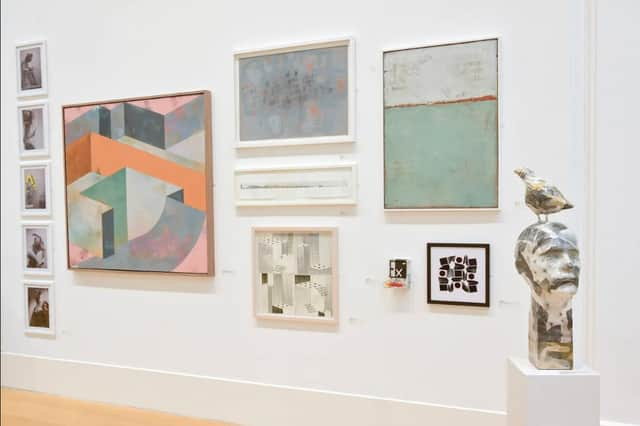
There are of course also excellent paintings, drawings and prints, like Katy McKidd Stevenson’s Four Red Clouds, for instance, although the eponymous clouds are upstaged by the boldly painted figure of a large lady with nothing on but a blue ribbon. Martin Rek’s Stillness Glen Coe is a lovely, low-key watercolour of quite Pre-Raphaelite intricacy, while Ali Scott’s As the Days Go By is a touching series of drawings on collage of a seated elderly woman that manages to suggest the tedium of sedentary old age and, while the collage suggests fragments of the woman’s memories. Tom Varley’s abstract and geometrical Leap Year looks like a giant container ship at sea. Michael Miller deploys a similar abstract geometry to great effect in Everything We Thought We Knew, but the stormy sea itself features in Michelle Cohen’s Bass Rock of the Blues by Moonlight which looks like a painting but is described as mixed media on glass. The main room is commanded, however, by Rhona Taylor’s big wall painting Fading Light, bands of red graduated from dark to light against clear blue. There is of course much else to admire or indeed puzzle over, but Tori McLean’s two life-sized dancing puppets with associated musical boxes do deserve mention for their sheer daft charm.

Meanwhile the SSA is also showing 30x30, a big range of small unframed works, some very attractive, displayed for you to leaf through like LPs in a record shop, while downstairs in the same building Modern Miniatures in the Academicians Gallery is a display of even smaller works painted within strict size limits by familiar artists. There are for instance characteristic, but unusually tiny works by Will Maclean, Henry Kondracki, Toby Paterson, Marian Leven, and others. Leena Nammari’s tiny cyanotype and silver windows are particularly lovely. Derrick Guild does often work on this scale. His wolf’s eye and goat’s eye are typical but are striking nevertheless. It is odd timing though. These little works would have been perfect for Christmas stockings.
Some of the prints in the Fine Art Society’s annual Print Show are equally desirable. They include some beautiful works by artists like DY Cameron, Ian Macnab, William Wilson and Ian Fleming, but also by less familiar names including striking prints by the Bauhaus trained German print maker Klaus Kranz.
SSA 127th Annual Exhibition until 4 February; Modern Miniatures until 8 March; The Print Show until 7 February
The Scotsman’s arts newsletter is now sent twice a week - subscribe today
Want the latest Scottish headlines sent directly to your phone? Sign up to our new WhatsApp channel here.
Comments
Want to join the conversation? Please or to comment on this article.