
Art reviews: Mike Nelson | Jonathan Baldock
Mike Nelson’s Fruitmarket Gallery show – set to be a highlight of the Edinburgh Art Festival – is an intensely moving examination of the places where people live and how they are shaped by a wider political context, writes Susan Mansfield
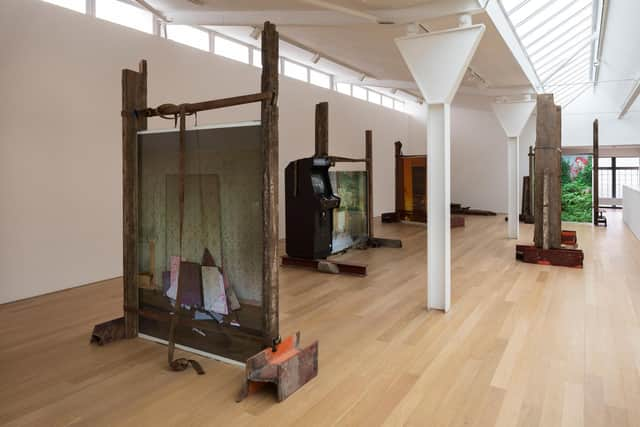

Mike Nelson’s major new installation work for the Fruitmarket Gallery is something of a coup for Edinburgh, and looks set to be one of the highlights of Edinburgh Art Festival. Nelson, who represented the UK in Venice in 2011 and has been shortlisted twice for the Turner Prize, has carved out a practice making immersive installations from salvaged materials which are suggestive of stories. But they’re big works and the chance to see a new one built from scratch is rare.
At the Fruitmarket, the “story” is woven between the three distinct spaces of the gallery. Nelson has been based in the Warehouse space for two months, building the work on site. The three elements appear separate, but are part of a single vision. The magic of the show ignites when the three work together, but this is also risky: I suspect it might not work for everyone.
The lower gallery houses a series of photographs Nelson took in the Turkish city of Mardin, in the predominantly Kurdish south-east region, in 2012. The pictures show a city in flux as new infrastructure is installed for drainage and broadband: trenches dug everywhere, piles of rubble on every corner. It’s like a giant earthwork and Nelson plays on this idea, part prehistory, part Robert Smithson. Ancient foundations are dug up, the past of this intriguing multicultural city briefly exposed, then filled in again or destroyed.
He makes the gallery feel a bit like a subterranean excavation with the photographs mounted low on the wall next to tiny benches and lit by workmen’s lamps. It’s like a pause in time in which different eras collide, and old foundations become part of modern reconstructions.
Upstairs, the focus shifts to the Heygate estate in South London where Nelson worked on a major project with Artangel in 2014. He had hoped to deconstruct an empty block of flats from the 1970s estate, which was then awaiting demolition, and build sections of them into a pyramid or zigurrat. But the project fell apart amid criticism that the art was part of the gentrification of an area from which working-class residents had been evicted. The estate was later demolished, and replaced by new largely private developments.
Here, Nelson’s photographs of the vacated flats are shown large-scale, back-to-back, mounted in sculptural structures made from timbers and girders, some from Nelson’s previous works, others from sites around Edinburgh. Almost life-size, they convey a sense akin to being in these now-demolished spaces. The melancholy of peeling wallpaper and discarded objects like a hamster cage lying in grass covey traces of the lives once lived here. It’s powerful stuff.
The hairs on the back of my neck were prickling nicely by the time I got the Warehouse space where Nelson delivers his pièce de résistance. Inside it, he has built a lifesize replica of sections of two of the abandoned flats. One room houses a huge digital photographic printer dating from 2014 (now considered obsolete technology) on which all the photographs in the show were printed.
The detail is masterful: the rusting desk lamp, William Hill calendar, dust mouldering in the corners, the Stairway to Heaven graffiti on the printing machine. It has the uncanny chill of abandoned spaces with enough left in them to evoke the presence of past inhabitants. Although it has just been built, it feels like it has been here for years.
The whole thing has an elegant circularity which threatens to tie bits of the brain in knots. The photos were made here, in this time capsule, which are themselves time capsules. And, just in case that wasn’t enough, one of the rooms contains a scale model of the ziggurat he hoped to build from flats like these - perhaps even from these very materials.
The self-referentiality could become insular, but Nelson knows better than to let the whole thing turn in on itself. This is about places where people live, how they are shaped by a wider political context: inclusion, idealism or submission to market forces. Improvement and demolition happen, outside of most people’s control. The past is part them – built into them, or destroyed in the building. Nelson’s own practice makes art out of what is discarded. This latest installation is not only clever and well made, it’s perhaps also a profound reflection on his own modus operandi.
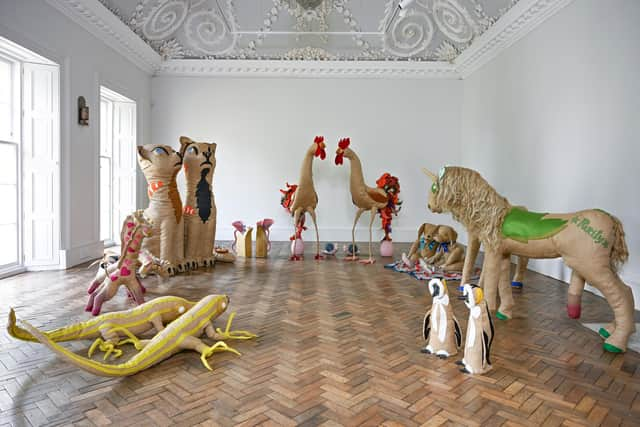
Meanwhile, a new commission by London-based Jonathan Baldock has been unveiled at Jupiter Artland for Edinburgh Art Festival. WYRD, in the Ballroom, is an assembly of animals immaculately crafted from textiles and ceramics. There are pairs of cats, lizards, giraffes, penguins, constructed in part using toy-making manuals from the 1970s and 1980s. Look closely and you will see that some also have human features – faces, hands, feet – which are modelled on the features of Baldock himself and his partner Rafal Zajko.
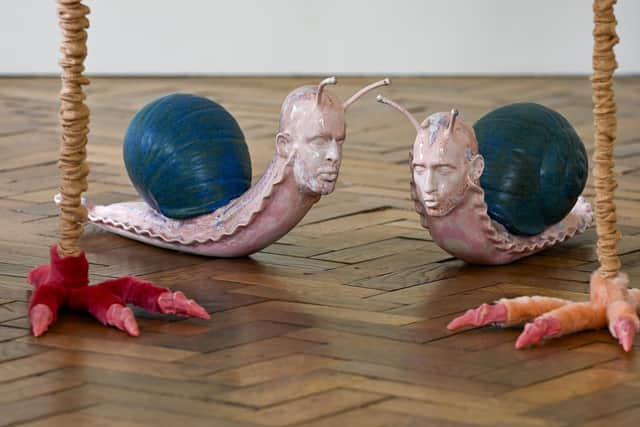
The accompanying text explains that all are species which have been scientifically observed to engage in same-sex sexual behaviour. Queerness, then, is part of the natural world, indeed evidence of it has been underreported. Baldock uses the old Norse “wyrd”, with its overtones of supernatural otherness or transformation.
All of which is fine. The creatures are more quaint than uncanny or transgressive. There are bows and appliqued hearts. The penguins are so adorable I could steal them. But I don’t feel it is telling me anything new.
A further installation, Warm Inside, first shown in Sweden in 2021, is in the Lower Steadings Gallery until the end of July. This is a collection of suspended pods, cocoon-like structures, beautifully made of basketry and hand-spun, naturally dyed wool. Through small openings, we glimpse a ceramic face or a hand, again modelled on the artist’s own body. The scent of the dried lavender used in some of the cocoons – a natural sedative and antiseptic – permeates the warm, dark space.
Changes – internal, external – need safe spaces in which to happen. This work is about bedding in, allowing things, ideas, lives to incubate. It’s about taking the time you need, being kind to yourself, knowing when you need to retreat. Again, all good, in fact, impossible to argue with. However, as with WYRD, one finds oneself in a closed circle. Instead of opening up a space for thought, these works let you know, in the nicest possible way, what you should be thinking. All you can do is agree that, yes, you are, and quietly take your leave.
Mike Nelson: Humpty Dumpty until 5 October; Jonathan Baldock at Jupiter Artland until 28 September (Warm Inside until 27 July)