
Art reviews: Making Waves, Breaking Ground | Summerhall Arts Annual Group Show
An impressive group show at the Bowhouse in St Monans brings together 11 artists who engage with the natural world in very different ways, writes Susan Mansfield
Making Waves, Breaking Ground, Bowhouse, St Monans ★★★★
Summerhall Arts Annual Group Show, Summerhall, Edinburgh ★★★
You can’t escape nature on the drive to the East Neuk of Fife: golden barley fields roll down towards the sea, road verges bloom with wild flowers. So perhaps its no surprise that, for its third annual exhibition at Bowhouse, Making Waves, Breaking Ground, Sophie Camu Lindsay’s Space to Breathe brings together 11 artists who engage with the natural world.
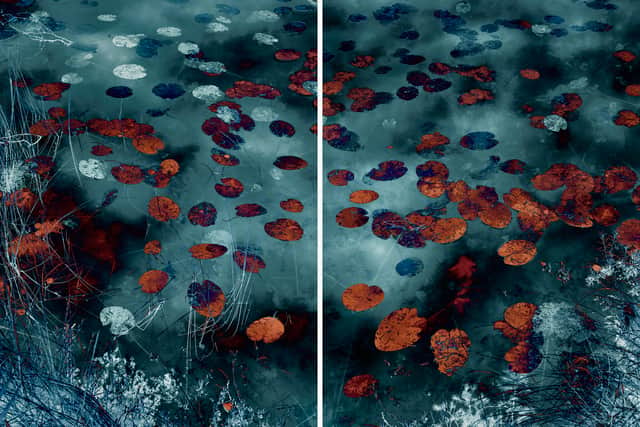

However, there is almost nothing here that looks like a conventional landscape painting. This is a gathering of contrasting approaches and propositions which tackle the complexity of being an artist who engages with nature. The artists come from Scotland, the UK and Europe; Space to Breathe has partnered with London gallery Purdey Hicks to bring some of them to Scotland for the first time.
Some, like Julie Brook, are well known. A land artist based on the Sound of Sleat in Skye, she works on large-scale outdoor sculptural projects, often in very remote places. However, unusually, she has just completed a work a few miles from the Bowhouse on the coast just north of Cellardyke, a curving stone pathway into the sea which was commissioned as part of the nationwide Beach of Dreams project.
Brook has a drawing practice which runs parallel to her land projects, and it is a rare privilege to see a group of these works brought together, stretching back to the 1990s. Like her land sculptures, they are formally rigorous, pared down to a kind of fierce simplicity, and are often made with materials from the places where she makes land art: red sand from Namibia, sea foam from Mingulay. Syria 7 Contour Drawing is unusual in its level of detail, an insight into one aspect of the practice which underlies her sculptural forms.
Orkney-based Samantha Clark, last seen in the RSA’s In Orcadia show after winning the organisation’s inaugural MacRobert Award, looks mainly at water. While her technique is detailed, meditative and time-consuming, her work, like Brook’s, has intense focus and structural formality, looking down into the ocean depths, or across at horizon lines.
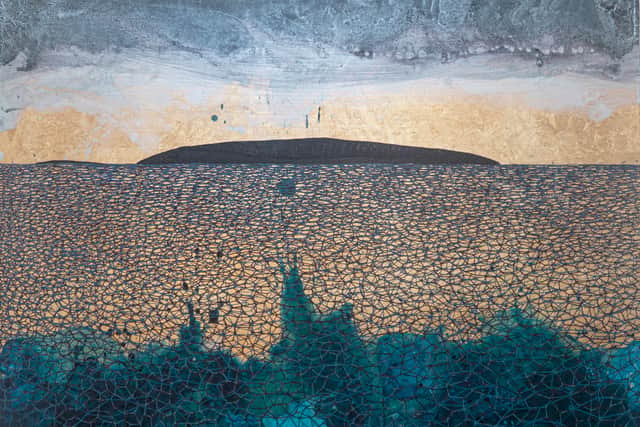
Clark works by laying down a fine hand-drawn grid pattern over deep colour, or covering a canvas with dense, repeating marks to suggest light, haar or waves. She often uses metal leaf and mica to create reflection or transluscence. Everything she does is carefully observed and processed in a considered, committed way, which brings her into conversation with an artist like Brook, even though their work looks very different.
There is a elemental thread running through the exhibition: Brook on earth, Clark on water and Alexander Lindsay on air, with a new group of works created in the studio by photographing smoke. These semi-abstract pieces, some of which look like distant galaxies, actually make air visible and map how it moves.
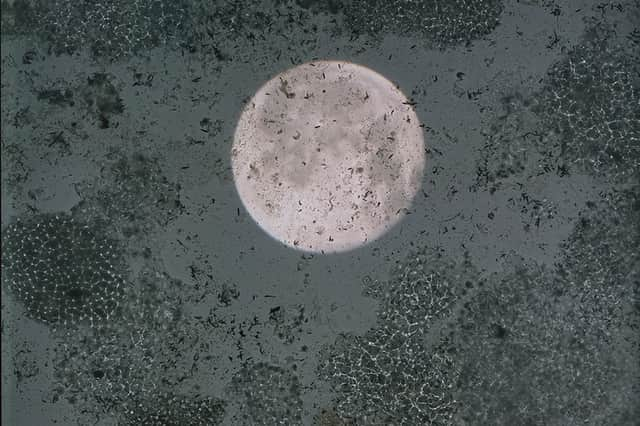
Much of the rest of the show is photography of one kind or another, though the action of the camera (where there is one at all) is often complicated by the artist. It’s always a pleasure to see work by Susan Derges, the master of cameraless photography. Her pictures of frogspawn by moonlight are magical. (The moon as a motif waxes and wanes through much of the exhibition.)
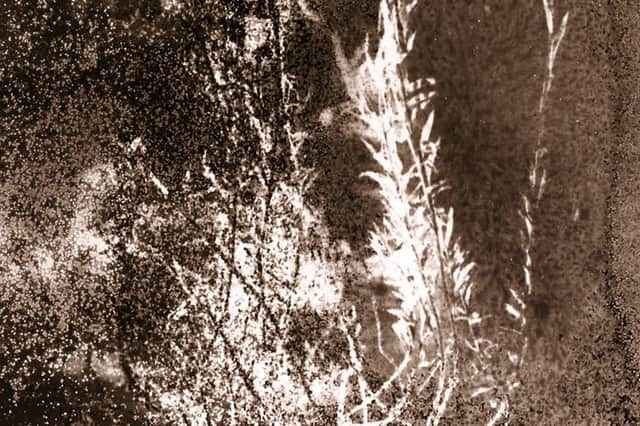
French artist Anaïs Tondeur, in her Chernobyl Herbarium project, makes rayograms (another cameraless photographic form) of plant and fungi samples taken from the exclusion zone at Chernobyl. The images are vivid and ghostly, haloed with what looks like dust, though I’m told it’s actually radiactivity. These works are prints made from the original rayograms which are themselves radioactive and must be kept in a lead box.
German Kathrin Linkersdorff photographs tulips by letting them dry out, removing pigment, then adding it again and photographing them submerged in water. The results are gorgeous, but there is a built-in sense of distance; we might not fully understand how they are made, but we know they are works of artifice. Strangely, Jonathan Delafield Cook’s breathtakingly detailed drawings of barnacles, icebergs and a Bottlenose dolphin have a similar effect.
There are three photographic artists from Finland, led by Jorma Puranen, a founding member of the Helsinki School, whose landscapes are always a translation, seen in reflection, for example, or through glass beaded with water drops. We are aware we are looking at a created image, never simply a landscape to admire. Sandra Kantanen and Santeri Tuori work for a similar sense of disruption, Kantanen by painting digitally over her photographs, Tuori by layering multiple images taken at the same spot.
There is such a broad range of work in the show that there is no single curatorial through-line. Rather, in the open space of the Bowhouse, where the works are installed on free-hanging mounts, visitors can make their own pathway, finding their own connections and contrasts. They will see some wonderful work on the way.
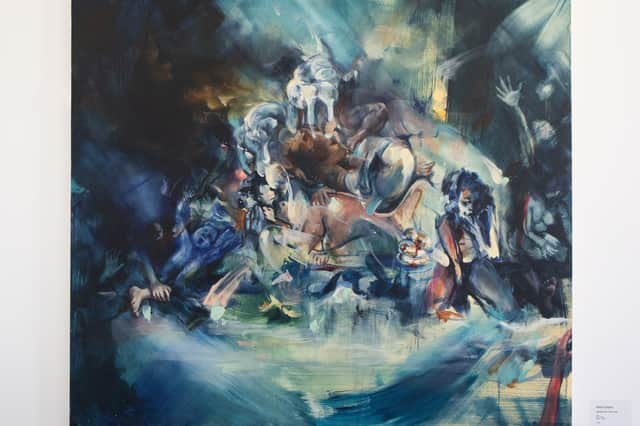
It’s all change this year at Summerhall since the arts complex in Edinburgh’s former vet school was brought back from the brink in the spring. One change seems to be that the wide-ranging festival visual art programme has been replaced by the Summerhall Arts Annual Group Show selected from an open call. While one feels a little disappointment, one must be glad that Summerhall survives, and rejoice in a new platform for the work of (mainly) local artists.
There is a broad range across the three galleries in media, materials and experience: some of the artists are new graduates, others have many years’ experience. With just one work per person, it isn’t possible to get a wider sense of an artist’s practice, and overall the quality is mixed, but there are many things worth seeing.
The War Memorial Gallery has some excellent painting, including Anna Somerville’s large, expressive work, Waterfall, Gemma Hare’s Lapping, and small landscapes by Yasmeen Khan and Sarah Bold. There’s a fine etching by Georgie Fay, a vivid pen portrait of a face in profile by Emma Claire Fallon, and a bewitching photograph of a bird sitting on the handle of a traditional-style kettle by Patricia McCormack.
Across the corridor, the bright Sciennes Gallery houses several works by students who graduated from Edinburgh College of Art last month, Amy Mclean, Tash Runciman, Elana Mulligan and Hattie Quigley, along with a succinctly witty embroidery by Jenny Mason and a small, strange landscape by Alasdair Wallace. Yulia Kovanova’s From Where I Stand, details of rooftops and chimneys painted in acrylic on aluminium, make an impressive set.
Upstairs in the Lab Gallery, the glass cases house mainly three-dimensional objects: Ruaridh Law’s deck of tarot cards; Becky Brewis’ photographic print envelopes remade in ceramic (“Colorama - we take care of your memories”); Catriona Clark’s giant Lovehearts. Vicky Higginson’s impressive glass battleaxe, Defense Mechanism III, and Monika Fejes’ striking textile work, Fragile Armour, seem to address a similar theme.
Ross Dickson’s Three Lobed Entities, which looks like a machine for scientific observation, is completely at home in this room even if it’s a little difficult to unravel. However, some of the best works here are Peter Dibdin’s photographs of his elderly mum and Chad McCail’s Arms Manufacturer. This sculptural figure flashes open his red coat to reveal tanks, missiles and war planes sewn into the linings; his head is a credit card machine. Subtle it’s not, but it is enormously timely.
Making Waves, Breaking Ground until 31 August (closed 5-15 August); Summerhall Arts Annual Group Show until 21 September
Comments
Want to join the conversation? Please or to comment on this article.