
Art reviews: Jaune Quick-to-See Smith | Shen Xin
Weaving together ancient pictographs and modern stereotypes, Jaune Quick-to-See Smith offers us a complex, multi-dimensional perspective on Native American life, writes Susan Mansfield
Jaune Quick-to-See Smith: Wilding, Fruitmarket Gallery, Edinburgh ★★★★
Shen Xin: Highland Embassy, Collective, Edinburgh ★★★
Native American artist Jaune Quick-to-See Smith was creating this show for the Fruitmarket Gallery when she died in January, aged 85. Her first exhibition in Scotland became her first posthumous show in the world, and the tone of it reflects both those things, in part survey and memorial, in part a show shaped by a living artist, driven by her current concerns.
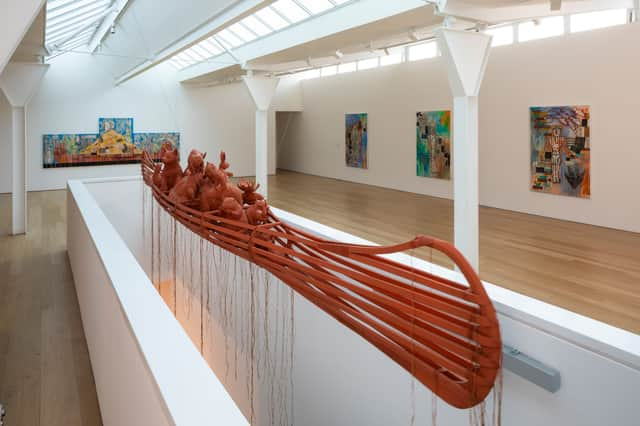

Smith emerged as an artist in the 1970s, making work which was fuelled almost equally by her identity as an enrolled Salish member of the Confederated Salish and Kootenai Nation, and by her immersive study of modern European and American art, from Picasso and Kurt Schwitters to Abstract Expressionism and Pop Art. She developed a visual language which was arresting in its formal qualities but could never be separated from her concerns for Native American rights, and later, for the environment. Her show at the Fruitmarket begins an Attached to Land season in which the gallery will explore issues of ecology, land and nature.
The earliest works here are from the Montana Memories series she made in the late 1980s, bringing together the qualities of abstract painting - weathered textures, precise colour rhythms - with simple outlines of things she recalled from childhood: pots, jugs, trees, horses.
Some of the most striking works come from her I See Red series, begun in 1992, the year in which America celebrated the 500th anniversary of Christopher Columbus. The title has a double meaning: angry at the racism and white-washing of history, yes, but also a quietly determined witnessing of the “red” perspective.
Three of these feature an outline of an animal - elk, bison, horse - elegant and elemental, almost like cave paintings. Around and through them are collaged other elements: stories cut from newspapers, slogans from advertising, pictograms and petroglyphs from Native American history. Headlines about land rights and social issues are mixed with snippets of pop culture, ancient stone art with and a model dressed as an indigenous woman to sell Washington apples. In I See Red: The Past Shadows the Present, Smith uses the symbol of the snowman for the short-lived white man, a resilient red figure - perhaps a woman - nested inside it.

Her reworkings of maps, painted in the last few years, expose and subvert the meanings of these documents. American Slang Map (2023) is peppered not with place names but with the language of othering: immigrant, hippy, redneck, okie, hillbilly. American Citizens Map replaces the names of states with the names of leading figures in the Native American world, making a nonsense of the arbitrary state lines.
Two paintings reference the speech given in 1854 by Chief Seattle, the definitive text of which is now lost but which appeared to have argued for respect for the natural world and a shared stewardship of the environment. “All things of the earth are connected”, she paints into a collage of colours and objects.
Upstairs, she continues this theme with new works, made in the final months of her life with the assistance of her son, Neal Ambrose-Smith, also an artist. A lifesize canoe floats above the stairwell, bearing a crew of animals: bear, turtle, rabbit, wolf. This work is called All My Relations. Predators and prey travel together, coated in the red ochre pigment deeply valued in Native American cultures. They seem to point to a more peaceful way of inhabiting the world.
A new series of paintings, Tierra Madre (Mother Earth), combine expressionist brush work with versions of an ancient pictograph to celebrate a series of women environmentalists and activists, from Rachel Carson to Wilma Mankiller, the first woman to serve as Principal Chief of the Cherokee Nation. They become symbols: goddesses, protectors, witnesses.
On the back wall of the upper gallery is a huge triptych, Trade Canoe: Turtle Island. The trade canoe is a symbol of exploitation, and Smith’s painting holds that meaning while suggesting another. A canoe is transport, connection, communication, not plundering the land but exploring it, understanding it.
Smith’s art is inseparable from her activism but, viewed through an art lens, her conversations with Schwitters, Dubuffet, Rauschenberg, even Andy Warhol, place her in that lineage. In 2023, she became the first Native American artist to have a major retrospective at the Whitney Museum of American Art in New York.
This is art as activism, yes, but there is a complexity to it which is not always obvious at first. Weaving together ancient pictographs, modern stereotypes, land rights, social issues and pop culture, she offers us a perspective on Native American life which is as complex and multi-dimensional as the rest of contemporary America. As well as anger, there is playfulness, celebration and even hope.

In the end, Smith’s illness prevented her travelling to Scotland where she had hoped to explore our own complex history with regard to land rights. Chinese artist Shen Xin, by contrast, has settled on the Isle of Skye and her first solo show in Scotland, Highland Embassy at Collective, makes connections across the world with other “Highland” territories.
The three works in Collective’s City Dome are all forged from the interplay of words and images. Bearing fruit of fondness is a film shot in black and white 16mm around the artist’s home on Skye. The film has been processed using the acidic leaves of the cotoneaster plant, brought to the UK in the 19th century from Xin’s part of China.
Tender images of home, animals and landscape are juxtaposed with a complex poem about a hostile mother/daughter relationship - perhaps an allegory for one’s motherland? - read by the artist in Chinese at a hurtling pace, as if trying to outrun the storm which howls through the soundtrack. Xin gasps for breath reading it. There are subtitles, but it’s hard to keep up.
Child of the Mountain is a fable-like tale set in Tibet about poverty, exclusion, loss and the stewardship of natural resources. It is written on the wall using natural inks in Tibetan and English, and Xin shows six of her painted illustrations.
Solar Wheels is the longest and most complex of the three. A Uyghur folktale about a wooden horse which can fly and the rescue of a princess is recounted in Uyghur, paired with film made in British Columbia on Super8, in collaboration with children and adults from the Xeni Gwet’in First Nation.
Both the Xeni Gwet’in and the Uyghur are involved in the repatriation of or care for wild horses, and the camera canters and leaps, mimicking horse movements. Behind the Uyghur narration, we hear the voices of the Xeni Gwet’in people, and the sounds of horses. Combined with the ever-shifting camera, there’s a lot going on, and the story - delivered in blocks of subtitles at the end of each chapter - is rendered in archaic language.
It’s a show about stories, but one in which the act of storytelling is also disrupted. Connections are made across landscapes and languages, between human and non-human creatures, but they are rarely straightforward. Perhaps, as in Smith’s work, there is an awareness of interconnectedness, but for Xin this is set alongside an acknowledgement of how difficult this is to achieve.
Jaune Quick-to-See Smith: Wilding runs until 2 February; Shen Xin: Highland Embassy until 21 December
The Scotsman’s arts newsletter is now sent twice a week - subscribe today
Want the latest Scottish headlines sent directly to your phone? Sign up to our new WhatsApp channel here.
Comments
Want to join the conversation? Please or to comment on this article.