
Art reviews: Dear Earth | Extraction
This year’s slew of environment-themed exhibitions continues with two thoughtfully curated group shows, writes Susan Mansfield


Dear Earth, Kirkcaldy Galleries ★★★★
Extraction, Jupiter Artland, near Edinburgh ★★★★
Maybe it’s because it’s spring, or because it’s the tercentenary of James Hutton, or maybe it’s just something in the ether: whatever the reason, the slew of climate and earth-related art exhibitions continues.
Dear Earth at Kirkcaldy Galleries, the 20th anniversary show for Fife Contemporary, presents the work of nine artists and - like Inverleith House’s Earth Matters - celebrates the blurred boundaries between contemporary art and contemporary craft. The theme is broad, and far-reaching: “The impact of human activity and the declining health of the planet”.
Beautifully put together, with a superb activity area suitable for both adults and children, it’s a great place to consider a spectrum of approaches. How do artists embrace ecological concerns? And how do such concerns inform - and even change - artistic practice?

The work of printmaker Ade Adesina always stands out both in terms of skill and imagination, and this is a welcome chance to see again the monumental six-panel linocut, Salt Lake, he made for his show at Edinburgh Printmakers in 2024. Concerns such as climate change, deforestation and energy policy are important to his practice: Salt Lake shows a motorboat resting on dry, cracked earth, piled high with flowers.
However, his vision is also playful, even surreal in the way he collages objects and living things, from sea urchins to baobab trees, a wind turbine to a curling stone, plays with scale and builds compositions like the fantastical machine in Parallel. His work blends Scotland and Africa, landscape and narrative, serious issues and gentle irony. While ecological concerns are often present, and might even be integral, they will never be the limit of his scope.
Sculptor Helen O’Brien takes a different approach, focusing on the specific - in this case, fungi - caring for and making evident a part of the natural world which might be overlooked. Her bronze cast of a large birch polypore fungus, Fruiting Body, is accompanied by a “muster” of other fungi she has made and collected.

Plastic objects found on beaches fuel the practices of Jenny Pope and Jeni Reid. Pope’s Tools for the Optimistically Challenged make plastic detritus into homespun assemblages which she names the Anxiety Softener, Status Quo Challenger, Shared Rage Acknowledger and (possibly my favourite) Wry Smile Collector, among many more. In this, she manages a kind of magical transformation in which a problem material, and source of very real ecological anxiety, is softened without being diminished.
Naomi Mcintosh’s Scarcity of Song uses steam-bent wood to make a graphic representation of the songs of 70 endangered or declining bird species, creating an intricate mobile in which each of the 70 parts measures that bird’s average wingspan. Designer Will Carey celebrates the resilience of common plants, creating ceramic containers which he links via wicking cord to mid-century vessels. Susie Johnston’s impressive sculpture ‘Reclamation - to cry again’ is made from hundreds of leaves shaped from clay found at the sites of decommissioned oil fields, glued together using North Sea crude oil.
Many photographers today are concerned with the ecological impact of chemical photographic processes, and Scott Hunter puts some of these (literally) under the microscope in his large-scale abstract images of chemical interactions between silver nitrate and soil. Zoe Hamill takes a different approach, taking pictures on and around West Lothian shale bings (now recognised as important sites for biodiversity) using broken cameras and out-of-date chemicals, which give the work an intriguing irregularity.

Shale bings play an important part in Extraction, the spring show at Jupiter Artland, which concerns itself with energy, and specifically energy within its own locale. Central to the show, in the Stables and Ballroom, is the premise that the sculpture park sits amid three energy cycles: the detritus of the 19th century shale industry; the offshore oil industry - the Forties pipeline docks nearby - and today’s renewables: Jupiter’s array of recently installed solar panels produce all the park’s electricity and then some.
The shale bings were important to artist John Latham, co-founder of the Artist Placement Group, who spent time working with the Scottish Development Agency in the 1970s. The bings were then considered an eyesore and earmarked for demolition, but he spoke out for their retention, describing them as “process sculptures” and renaming the group visible from Jupiter Artland as “The Niddrie Woman.” His ashes are scattered on the bings.
READ MORE: Art reviews: Joan Eardley | Mona Yoo
This show is a rare chance to see a Latham assemblage in Scotland, and The NU Niddrie Heart (1991) draws directly on the bings. It’s a strange and intriguing work, a series of six identical glass structures to which he has added old books, electrical wire, lightbulbs and, in one case, a tiny wax face. There’s an abstract concern with shape and form, a Beuysian concern with materials, an eye for detail, and a lot of thinking about energy. And something else, too: the artist’s alchemy, a sprinkling of transformation.
Another artist who looked hard at the West Lothian bings was Carol Rhodes. While her painting Deposits does not name the landscape specifically (her works rarely do), her large-scale drawing cites West Lothian as the inspiration. It’s not hard to see how its strangeness might appeal; the great sadness is she did not live develop it into a painting.
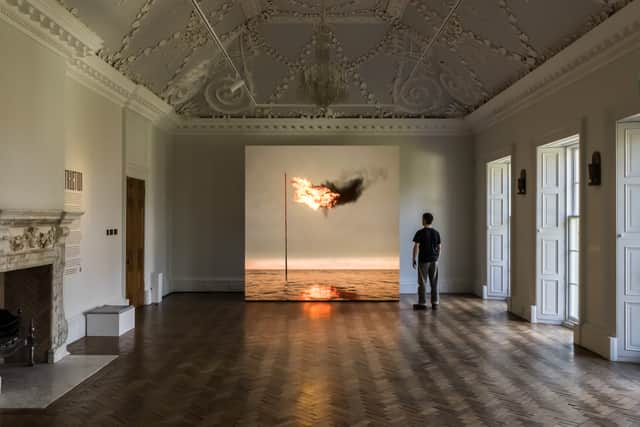
Along with these are works by three contemporary artists. Painter Siobhan McLaughlin’s Date of Exhaustion and Pioneer Species are made with pigment taken from the Five Sisters bings. John Gerrard’s simulation Flare (Oceania), created using a game-building engine and shown on a giant LED screen, is somewhere between a flag and a distress flare coming from the ocean itself. It was made with the South Sea islands in mind, imminently threatened by rising sea levels, but is entirely at home here, a stone’s throw from the flares of Grangemouth and Mossmorran.
It’s left to Marguerite Humeau to imagine something beyond the energy cycles of shale and petroleum with her strange and rather beautiful sculptures The Honey Holder and The Guardian of Termitomyces, accompanied by a soundscape by Bendik Giske. These works conjure a different vision of society, one which is interdependent and collaborative.
This, perhaps, gets to the nub of Extraction. By highlighting past energy cycles, it reminds us how we are all complicit in an attitude which freely extracts the earth’s resources. But it’s not enough simply to develop renewable energies to serve the same ideals of rampant consumerism. Art isn’t about finding answers; that’s true of both these exhibitions. But Humeau’s bees and termites seem to suggest we must think differently: not reimagining energy but reimagining how we think about our lives and our world.
Dear Earth is at Kirkcaldy Galleries until 13 September, then at St Andrews Museum from 30 September until 6 March 2027; Extraction runs until 26 July
The Scotsman’s arts newsletter is now sent twice a week - subscribe today
Want the latest Scottish headlines sent directly to your phone? Sign up to our new WhatsApp channel here
Comments
Want to join the conversation? Please or to comment on this article.